
SLIP ROLL MACHINE
Introduction:
In the world of metal fabrication and sheet‑metal work, a Slip Roll Machine (also known simply as a “plate rolling machine” or “roll bending machine”) plays a critical role. Whether you are working on light-gauge sheet metal or heavier plates, a slip roll offers a reliable, efficient method to bend, curve, or roll metal into cylindrical, conical, or curved shapes — tasks that are often difficult or impossible with conventional metalworking tools.
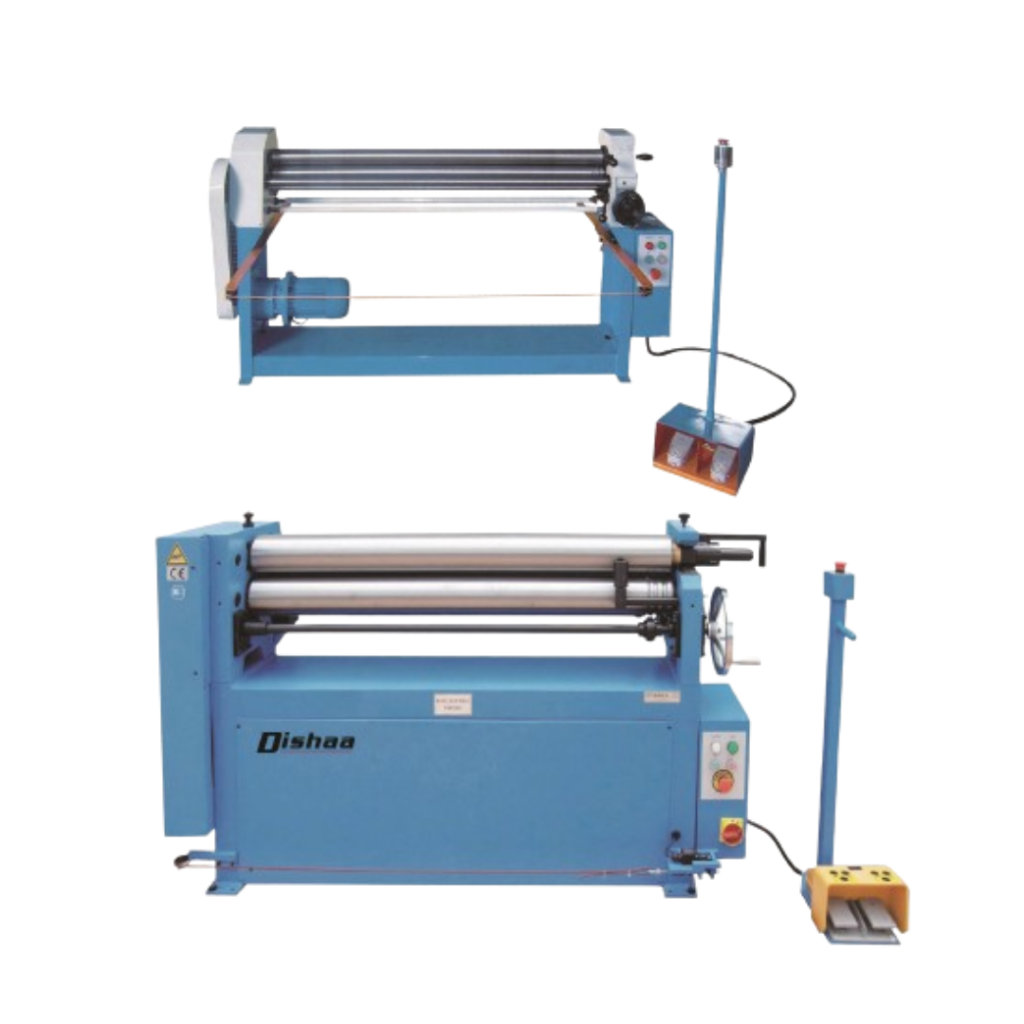
A slip roll machine typically consists of three (or sometimes four) rollers: two bottom rollers (which remain fixed or adjustable) and a top roller (which moves up and down). By feeding a flat sheet between these rollers and applying pressure, the machine incrementally bends the metal into a curve or cylinder. With repeated passes, the operator can roll the metal into pipes, tubes, tanks, curved panels, or any shape requiring a smooth radius.
Slip roll machines designed to meet the demands of small workshops, industrial fabrication plants, and custom metalworking shops across the UAE, GCC, and beyond. Our machines are engineered for safety, accuracy, and versatility — whether you need to produce cylindrical tanks, ducts, structural components, or decorative metalwork.
In modern fabrication, where flexibility, precision, and efficient material handling are key, a slip roll machine is more than a convenience — it’s often indispensable. This article delves into the core features, wide-ranging applications, and compelling benefits of using a slip roll machine in today’s metalworking environment, while also offering insights into proper selection, maintenance, and best practices.
How Slip Roll Machines Work
To appreciate the capabilities of a slip roll machine, it’s useful to understand its working mechanism:
1. The Roller Arrangement
– Top Roller (Pinch Roller): This roller presses downward against the metal sheet. Adjusting the vertical position controls the bending radius.
2. Feeding and Bending
– The operator inserts the flat metal sheet at one end.
– By adjusting the pinch roller, pressure is applied.
– The machine is then manually or motor-driven to roll the sheet through.
– With each pass, the metal curves more, until the desired radius or cylinder is achieved.
3. Multiple Passes for Tight Curvature
– Unlike hydraulic presses which apply one strong bend, slip rolling gradually curves the sheet across several passes. This results in smoother bends, less stress on the metal, and greater control.
4. Optional Back‑Up Plate or Slip Plate
– Some heavy-duty slip roll machines include a back or slip plate to support the curved sheet as it exits, preventing collapse or deformation, especially on longer or heavier sheets.
Features:
- Asymmetrical roll bending machine with 3 high strength steel rolls
- Fixed top roller, adjustable lower and rear rollers
- Standard series wire core groove
- Top roll swing out across cam lock
- Supplied with conical bending feature
Technical Parameters:
| Model | Max. rolling thickness (mm) | Max. rolling width (mm) | Dia. of roller (mm) | Motor power (kW) | Dimension (cm) | N.W./G.W. (kg) |
|---|---|---|---|---|---|---|
| DMER-1300x1.5 | 1.5 | 1300 | 75 | 0.75 | 180x65x110 | 280/340 |
| DMER-1300x2.5 | 2.5 | 1300 | 90 | 1.5 | 200x72x120 | 540/600 |
| DMER-1300x4.5 | 4.5 | 1300 | 120 | 2.2 | 200x76x127 | 750/830 |
| DMER-1550x3.5 | 3.5 | 1550 | 120 | 2.2 | 222x76x127 | 790/890 |
| DMER-2020x3.0 | 3.0 | 2020 | 127 | 4.0 | 270x87x130 | 1100/1200 |