
BANDSAW MACHINE
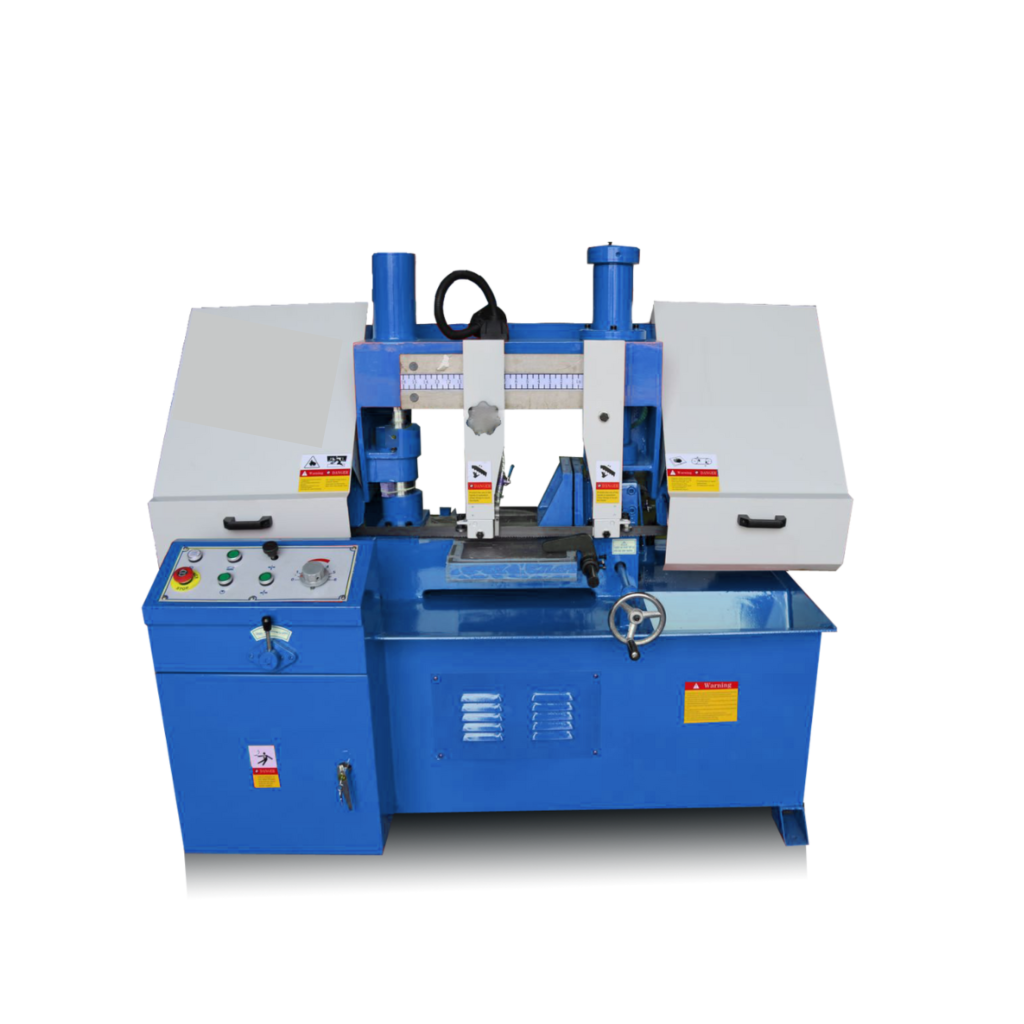
Introduction on Bandsaw machine:
In the world of metal fabrication, construction, and industrial manufacturing, efficient cutting of raw materials — especially steel bars, pipes, rods, and other elongated stock — is among the most fundamental yet critical operations. A bandsaw machine stands at the heart of this process: offering a versatile, precise, and cost‑effective means of cutting through a wide variety of materials with minimal waste and high repeatability.
A bandsaw machine operates with a continuous toothed blade (or band) that moves on two or more wheels, allowing the blade to run in a loop. The work material — be it round bars, square rods, structural beams, pipes, or rectangular profiles — is fed into the blade at a controlled feed rate. The result: clean, straight cuts, accurate lengths, and minimal material deformation. Unlike simple hacksaws, manual cutting, or abrasive wheel cutters, a bandsaw offers stability, safety, and speed — making it ideal for professional workshops and industrial environments.
Historically, metalworkers relied on handheld saws, abrasive cutters, or costly laser/plasma cutting for various cutting jobs. These methods often led to wasted material, inconsistent cuts, dangerous operations, significant heat zones, or excessive finishing requirements. The bandsaw machine revolutionized these operations. It combined power, precision, and convenience in a single package. By eliminating excessive heat generation and reducing the risk of metallurgical damage, bandsaws became the go-to solution for cutting ferrous and non‑ferrous materials without compromising material integrity.
Moreover, as fabrication demands evolved — with more complex parts, higher demand for accuracy, stricter tolerances, and faster turnarounds — the bandsaw machine has also advanced. From basic manual versions used in small workshops to heavy-duty, hydraulic‑fed, semi-automatic or fully automatic industrial bandsaws with coolant, blade tracking, and digital cut‑length control, it remains relevant. Today’s bandsaw machines serve industries ranging from steel trading and structural fabrication to heavy machinery manufacturing, automotive, oil & gas fabrication, and small‑batch metal shops.
For businesses in the UAE, GCC, or global markets where material availability, cost, and workflow efficiency matter, a high-quality bandsaw machine provides both competitive advantage and operational stability. It reduces reliance on external cutting services, saves time, cuts down material surcharge, and brings cutting operations in-house — giving better control over quality, lead times, and cost.
In short: the bandsaw machine is more than just a saw — it is a cornerstone tool for anyone dealing with metal fabrication, structural cutting, or industrial metal processing. Whether you’re running a small fabrication shop or a large‑scale manufacturing unit, using a properly selected bandsaw machine can significantly boost productivity, reduce waste, and ensure consistent quality across production runs
Features:
- Bandsaw machines are widely used across a variety of industries and fabrication workshops. Their versatility, ease of operation, and compatibility with multiple materials and profiles make them indispensable in many contexts. Below are common applications and industry uses:
- Metal Fabrication & Structural Steel Workshops
– Cutting structural steel beams, channels, angles, and plates for building frames, supports, structural components.
– Processing pipes, tubes, and hollow sections for construction, scaffolding, and frameworks. - Manufacturing & Machinery Workshops
– Cutting raw metal bars and rods for machine parts, shafts, shafts blanks, and components.
– Preparing raw material for CNC machining, turning, milling, or forging.
– Fabricating brackets, supports, frames, and parts needed for industrial machines. - Automotive and Heavy Equipment Industry
– Cutting chassis components, beams, structural members, exhaust pipes, frames, and supports.
– Preparing metal stock for manufacturing parts, engine mounts, structural brackets, and reinforcements. - Oil & Gas, Petrochemical, Construction Sectors
– Cutting pipes and tubes for pipeline infrastructure, structural supports, scaffolding, and platforms.
– Fabricating structural beams, support frames, platform members, and metal housings. - Workshop, Repair & Maintenance (MRO)
– On‑site cutting of replacement bars, shafts, rods, and structural members for repair or retrofit works.
– Cutting scrap or leftover material for reuse, reducing waste and optimizing material usage. - Fabrication for Infrastructure & Civil Works
– Cutting materials for structural frames, gates, fences, railings, staircases, rail supports.
– Metalwork for bridges, platforms, handrails, beams, and panels. - Educational & Training Institutes
– Teaching metal cutting, setup, safety, and fabrication techniques using a practical, manual or semi‑automatic bandsaw.
– Demonstration of proper cutting practices, material handling, and machine maintenance for students and trainees.
Benefits:
- Blade Wear and Consumable Costs
– Blades wear over time and need regular replacement — especially when cutting hard or abrasive materials; this adds to operating cost.
– Incorrect blade selection or poor tensioning can lead to fast wear or blade breakage. - Limited to Linear Cuts (Unless Advanced Mitering)
– Standard bandsaws produce straight cuts; curved cuts or complex profiles require additional steps (not suitable for all jobs).
– Mitering or angle‑cutting capabilities exist, but limited in range compared to CNC plasma/laser cutters for intricate shapes. - Slower for Very Large or Thick Material Removal
– Very thick plates or heavy beams may require slower feed rates and multiple passes; for extremely heavy stock, cutting may be slow compared to specialized cutting machines.
– Some structural sections may exceed machine capacity (throat, cutting height, motor power). - Maintenance & Operational Overheads
– Requires periodic maintenance — blade tensioning, coolant system servicing, coolant replacement, blade changes, lubrication, alignment checks.
– For hydraulic models, maintenance of hydraulic lines, pumps, and vices is essential. - Safety & Proper Handling Required
– Operator must follow safety protocols — secure clamps, guards engaged, proper PPE — otherwise risk of accidents exists.
– Blade breakage or improper feed may cause serious hazards. - Noise, Coolant, and Chip Management
– Cutting heavy metal produces noise, metal chips, and coolant spray — workshop needs proper ventilation, chip/trash management, and noise control.
– Disposal of used coolant and metal shavings must comply with environmental and local regulations. - 6.10 Dependence on Proper Setup and Skilled Operation
– Incorrect blade selection, improper feed speed, or poor clamping can result in inaccurate cuts, wastage, or blade damage.
– Skilled operators recommended for optimal results — especially when cutting heavy or difficult materials.
Technical Parameters:
| SPECIFICATIONS | Units | DBSH4240 | DBSH4250 | DBSH4260 |
|---|---|---|---|---|
| Cutting circular | mm | 400 | 500 | 600 |
| Cutting rectangular | mm | 400*400 | 500*500 | 600*600 |
| Blade speed | m/min | 27,45,69 | 27,45,69 | 27,45,69 |
| Blade size | mm | 5000*41*1.3 | 5800*41*1.3 | 6650*54*1.6 |
| Main motor power | kw | 4 | 5.5 | 5.5 |
| Hydraulic motor power | kw | 0.75 | 0.75 | 1.5 |
| Coolant motor power | kw | 0.09 | 0.09 | 0.125 |
| Machine weight | kg | 1500 | 1900 | 2300 |
| Overall dimension | mm | 2460*1270*2000 | 2960*1470*2200 | 3250*1600*2300 |