
CNC LATHE MACHINE
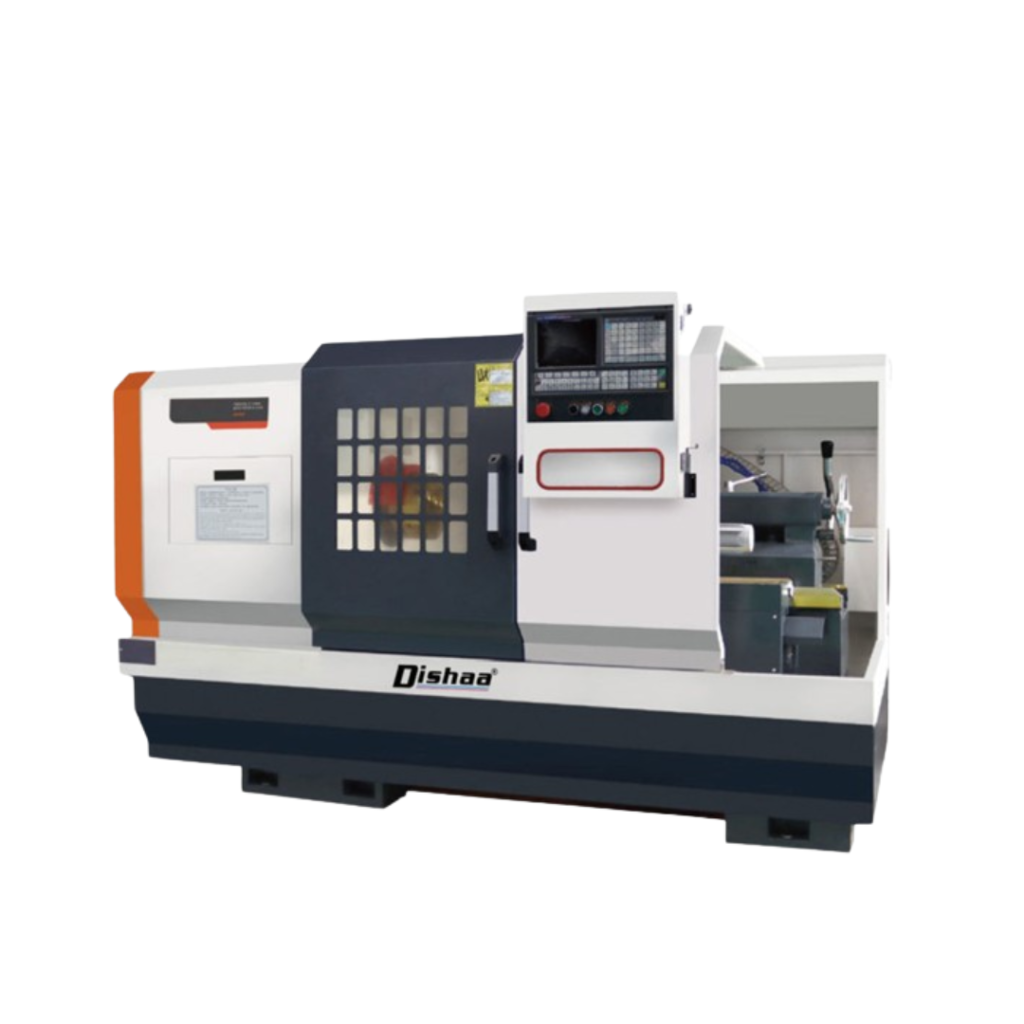
Introduction:
A CNC (Computer Numerical Control) lathe is an advanced machine tool used for shaping, cutting, and finishing materials such as metals, plastics, and composites. Unlike traditional manual lathes, a CNC lathe is controlled by a computerized system that directs the movement of the cutting tools and workpiece according to a programmed set of instructions. This technology allows for highly precise, repeatable, and automated machining, making CNC lathes a cornerstone of modern manufacturing.
The primary function of a CNC lathe is to perform turning operations, where the workpiece rotates around its axis while cutting tools remove material to achieve the desired shape and size. CNC lathes can also perform drilling, threading, grooving, and tapering operations, all within a single setup. The machine’s operations are controlled by a CNC controller, which reads programs written in specialized programming languages such as G-code. These programs specify tool paths, feed rates, spindle speeds, and other parameters to ensure accurate and efficient machining.
CNC lathes offer several advantages over conventional lathes. Their precision and repeatability ensure that every part produced meets strict tolerances, which is crucial in industries like aerospace, automotive, electronics, and medical devices. The automation of CNC lathes reduces the reliance on highly skilled manual operators, while increasing production efficiency and reducing human error. Additionally, CNC lathes provide flexibility, as a change in design or dimensions requires only a program update rather than physical adjustments to the machine.
In modern industrial applications, CNC lathes play a critical role in producing complex, high-quality components quickly and consistently. They enhance productivity, minimize material waste, and enable manufacturers to meet the increasing demands for precision engineering. The adoption of CNC lathes represents a significant advancement in machining technology, combining automation, versatility, and accuracy to meet the needs of today’s competitive manufacturing environment.
Key Information:
Function and Operation
The primary function of a CNC press brake is to bend metal sheets along straight axes.
The operator programs the machine with the desired bend angle, position, and sequence, and the CNC system controls the movement of the ram (upper tool) and the die (lower tool) accordingly.
Hydraulic or electric actuators typically drive the ram, depending on the machine type.
Components
Frame: The main structure providing support and stability.
Ram/Slide: Moves vertically to press the metal into the die.
Bed/Die: The lower platform where the metal is placed and bent.
Back Gauge: Positions the metal accurately for multiple bends.
CNC Controller: The computer interface for programming bends, angles, and sequences.
Advantages
Precision: CNC control ensures exact bend angles and consistent repeatability.
Efficiency: Reduces manual adjustments, speeding up production.
Flexibility: Can handle various metal types, thicknesses, and complex bending patterns.
Automation: Reduces human error and labor costs in large-scale production.
Applications
Manufacturing of sheet metal components for cars, airplanes, and appliances.
Fabrication of metal enclosures, brackets, frames, and panels.
Production of architectural and industrial metalwork requiring complex bends.
Safety Considerations
CNC press brakes are powerful machines; operators must follow safety protocols.
Modern machines often include safety light curtains, emergency stop buttons, and safety shields to prevent accidents.
Features:
A CNC lathe is a computer-controlled machine used to shape metal, wood, or other materials by rotating the workpiece against cutting tools. Its features distinguish it from traditional lathes:
Computer Numerical Control (CNC) System
Enables precise programming of operations like turning, threading, drilling, and facing.
Supports multiple operations in a single setup, reducing manual intervention.
High Precision and Accuracy
Achieves tight tolerances for complex components.
Consistent repeatability across multiple parts.
Automation and Efficiency
Can operate continuously with minimal human supervision.
Reduces production time and labor costs.
Versatility
Capable of machining various materials: metals, plastics, composites, and more.
Supports multiple cutting tools and operations.
Tool Turret/Tool Post
Allows for automatic tool changing to perform different machining operations.
Rigid and Sturdy Construction
Ensures stability during high-speed rotation and heavy cutting operations.
Advanced Safety Features
Equipped with emergency stops, interlocks, and protective shields for operator safety.
Importance:
Enhanced Productivity
CNC lathes can work continuously, increasing production output and reducing downtime.
High Accuracy and Consistency
Ideal for mass production of identical components with minimal errors.
Reduced Labor Dependence
Automation reduces the need for highly skilled manual operators for routine machining tasks.
Flexibility in Design
Can easily switch between different products or designs through programming changes.
Cost-Effectiveness in Long-Term Production
Minimizes waste of raw material due to precise cuts.
Lowers production costs through faster cycles and reduced errors.
Complex Component Manufacturing
Capable of producing intricate shapes and threads that are difficult to achieve manually.
Usage:
Controved by NC system, this machine could process different inner bore, ex-circle, circular conical surface and screw thread, especially suitable for the small and middle-sized shaft and plate work piece from rough processing to finish processing in batch. It has advantages like higher outomoticity, simpler programming and higher accuracy.
Technical Parameters:
| Specifications | Unit | DCK6152E | DCK6165E | DCK6185E |
|---|---|---|---|---|
| Max.swing dia.over bed | mm | 530 | 650 | 850 |
| Max.swing dia.over slide | mm | 280 | 375 | 500 |
| Maximum turning diameter (disc.) | mm | 520 | 650 | 850 |
| Max.work piece length | mm | 1000/1500/2000/3000 | 1000/1500/2000/3000 | 1000/1500/2000/3000/4000 |
| Maximum turning length | mm | 825/1325/1825/2825 | 900/1400/1900/2900 | 900/1400/1900/2900/3900 |
| Spindle nose | A2-8 | C11 | C11 | |
| Spindle bore | φ/mm | 90 | 105 | 105 |
| Spindle taper | φ/mm | 100/1:20 | 120/1:20 | 120/1:20 |
| Spindle speed | r/min | 30-150,90-450,315-1600 | 10-85,40-350,100-850 | 10-85,40-350,100-850 |
| Spindle shift mode | Three speed mechanical transmission,stepless speed regulation within the gear | |||
| Spindle motor power | KW | 7.5 | 11 | 11 |
| Chuck type | Manual Chuck | Manual Chuck | Manual Chuck | |
| Chuck size | mm | 250 | 320 | 400 |
| X axis rapid traverse | m/min | 6 | 4 | 4 |
| Z axis rapid traverse | m/min | 8 | 5 | 5 |
| X axis servo motor torque | N.m | 7.5 | 10 | 10 |
| Z axis servo motor torque | N.m | 10/15/22 | 15/22/30 | 15/22/30 |
| X axis travel | mm | 300 | 400 | 450 |
| Z axis travel | mm | 1000/1500/2000/3000 | 1100/1600/2100/3100/ | 1100/1600/2100/3100/4100 |
| Guide way type | Hard rail | Hard rail | Hard rail | |
| Capacity of tool post | 4 | 4 | 4 | |
| Tool shank size | mmXmm | 25X25 | 32X32 | 32X32 |
| Tail stock quill dia | φ/mm | 75 | 100 | 100 |
| Tail stock quill travel | mm | 150 | 250 | 250 |
| Tail stock quill taper | MT5# | MT6# | MT6# | |
| Total rated power | KW | 12/12/13 | 16/18/20 | 16/18/20 |
| Total rated current | A | 26/26/28 | 36/40/42 | 36/38/42 |
| Net weight | kg | 2900/3150/3500/4300 | 4000/4400/5000/5800 | 4200/4600/5200/6000/6700 |
| Machine dimension (LXWXH) | LXWXH(mm) | 2600/3100/3600/4800×1600×1670 | 3300/3800/4300/5300X1900X1900 | 3300/3800/4300/4800/5800X2000X2000 |