
CNC / NC PIPE BENDING
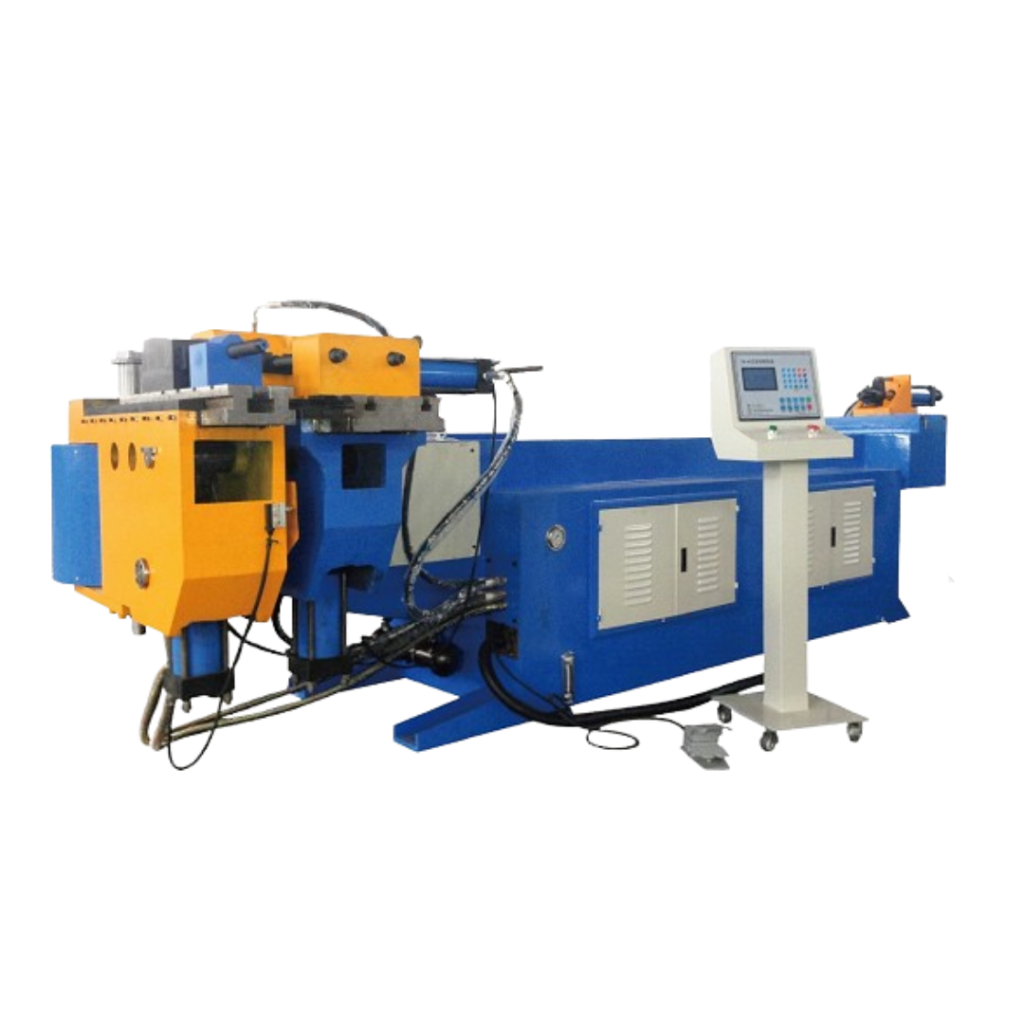
Introduction on NC / CNC Pipe Bending Machine :
NC/CNC Pipe Bending Machines evolved to meet the needs of high‑precision manufacturing and automation. In the earlier stages of industry, pipe bending was often performed with manual rollers or mechanical bending tools that lacked flexibility, precision, and repeatability. These manual methods are labor‑intensive and open to human error, particularly when bending complex shapes or working with materials that may spring back after bending.
In today’s advanced industrial landscape, precision metal fabrication is no longer a luxury — it’s a necessity. Among the most critical processes in modern fabrication is pipe and tube bending, and the emergence of NC (Numerical Control) and CNC (Computer Numerical Control) Pipe Bending Machines has completely transformed how industries handle this task. These machines offer unmatched accuracy, consistency, and efficiency, making them indispensable for sectors that rely on high-quality bent pipes and tubes, such as automotive, aerospace, HVAC, construction, and shipbuilding.
Today’s NC/CNC pipe benders use digital controls that precisely orchestrate back‑bend compensation, clamp positions, rotation, mandrel placement, and bend speed, ensuring the finished part conforms exactly to the design — whether that design involves simple bends or complex multi‑angle geometries.
This article explores everything about NC/CNC Pipe Bending Machines — why they are used, their key features, how they benefit operations, common applications, and limitations. Whether you are considering your first machine purchase or looking to expand fabrication capabilities, this guide will help you make an informed decision.
An NC/CNC pipe bending machine is a specialized equipment that bends metal pipes into specific angles and complex shapes through programmed control. Unlike manual or hydraulic bending, which depends heavily on operator skill and can result in inconsistencies, NC/CNC systems automate the process using digital input, ensuring every bend is accurate and repeatable. These machines can handle multiple axes, store hundreds of programs, and adjust for variables like spring-back, material thickness, and radius — all within milliseconds.
As product designs become more intricate and quality standards more stringent, manual bending methods fall short. This is where NC and CNC pipe benders shine. Whether you’re mass-producing automotive exhaust systems, forming fluid lines in oil and gas, or constructing architectural frameworks, these machines provide the precision and speed needed to stay competitive.
Moreover, with growing demand for smart manufacturing and Industry 4.0 integration, CNC pipe bending machines fit seamlessly into automated production lines. They not only increase throughput but also reduce material waste, lower labor costs, and ensure safer operation.
Why to Use an NC / CNC Pipe Bending Machine?
Precision and Consistency Across Bends
The primary advantage of NC/CNC pipe bending is precision. When working with pipes or tubes that must fit within tight spatial constraints (such as automotive frames or HVAC ducts), the angle must be exact. NC/CNC controls ensure every bend matches the programmed specifications, reducing the risk of misalignment in assembly.
Repeatability for High‑Volume Production
Manual bending methods are inconsistent and require significant operator skill to replicate the same bend repeatedly. In contrast, an NC or CNC bending machine stores programs that can be run repeatedly without variation — enabling consistent results across thousands of parts
Complex Bend Sequences with Multiple Angles
Many modern applications require pipes that have multiple bends in more than one plane. NC/CNC machines allow the operator to program these complex bend sequences with:
– Multi‑axis control
– Back‑bend compensation
– Bend angle tapering
– Return bends and compound radii
Material Versatility
NC/CNC Pipe Bending Machines can operate on a wide range of materials including:
– Stainless steel
– Mild steel
– Aluminum and aluminum alloys
– Copper
– Titanium
– High‑strength alloy tubing
The control system adjusts pressure, rotation, and compensation based on material properties, ensuring accuracy regardless of metal type.
Reduced Waste and Fewer Errors
A major cost in fabrication is material waste resulting from incorrect bending or scrap caused by human error. NC/CNC bending reduces this waste by executing bends with high precision — avoiding guesswork and reducing the need for costly rework.
Integration with Digital Fabrication Workflows
Modern production setups often use digital design tools such as CAD (Computer‑Aided Design) and CAM (Computer‑Aided Manufacturing). NC/CNC Pipe Bending Machines can import digital files directly, enabling a seamless workflow from design to production.
Features:
CNC Control System
The heart of any NC/CNC bending machine is its digital control system. It allows the operator to:
– Input bend angles
– Set bend sequences
– Save and recall previous programs
– Automatically compensate for springback
– Coordinate multiple axes for complex bends
High‑Precision Servo Motors
Servo motors provide smooth rotation and controlled movement with minimal backlash. This results in:
– Accurate bend placement
– Consistent speed
– Repeatable performance
Hydraulic or Electric Drive Systems
Most NC/CNC pipe benders use:
– Hydraulic drives for high‑force applications (thicker pipes or heavy materials)
– Electric drives for cleaner, quieter, and more energy‑efficient operation
Some high‑end machines offer servo‑hydraulic hybrid systems for advanced control and power.
Precision Mandrels and Supporting Tooling
To prevent deformation, especially in thinner walled pipes, machines use:
– Internal mandrels
– Roller dies
– Clamp dies
– Wiper dies
Digital Interfaces & Touchscreen Panels
Modern machines include touchscreen panels that:
– Display bend data
– Allow interactive programming
– Show error codes and maintenance schedules
– Enable import of CAD‑generated bend files
Safety Interlocks & Machine Guards
Industrial machines include safety features:
– Emergency stop buttons
– Protective guards
– Interlocks that prevent operation if guards are open
– Automatic shut‑off on fault
Material Sensing and Feedback Loops
Advanced systems include sensors that monitor:
– Pipe position
– Torque load
– Bend angle feedback
These feedback loops allow real‑time adjustments that maintain accuracy.
Program Memory and Storage
NC/CNC systems allow:
– Storage of multiple bend programs
– Naming and organizing jobs
– Recall for future production
This is crucial for shops producing repeat order
Mechanical Characteristics:
The microcomputer control is adopted with strong functions, high extensibility, English subtitles and dialogue-based operation, easy to learn and understand. Set speed by segmentation with high precision of elbow plpos. The sixteenth level elbow pipe data setting and storage, and remarkably smooth assembly of work pieces of many angles. The functions of reloading with auxiliary shoving and slowly retuming the core can beachieved. The thin-wall pipes can be bent and manufactured. Extensively used in large ship building and repair, boler, petroleum pipeline and auto spare parts
Conclusion:
An NC / CNC Pipe Bending Machine is an essential investment for modern manufacturing environments where precision, speed, and consistency are priorities. From automotive systems to aerospace frameworks, HVAC installations to industrial piping, these machines dramatically improve production quality and efficiency.
The demand for pipe bending accuracy and repeatability has grown dramatically with modern industrial and fabrication requirements. A NC (Numerical Control) / CNC (Computer Numerical Control) Pipe Bending Machine is a precision machine designed to bend pipes and tubes into exact radii and shapes based on programmed input values. Unlike traditional manual or mechanical benders, NC/CNC machines incorporate digital control systems that allow operators to program complex bending sequences — ensuring the same angles, radii, and shapes are repeated consistently across production runs.
Pipe bending is a fundamental process in many industries where curved or angular piping systems are part of the final product. These industries include automotive exhaust and chassis systems, shipbuilding, aerospace, HVAC systems, construction frameworks, oil & gas pipelines, industrial equipment, and architectural metalwork. The precision of the bend and the structural integrity of the pipe are critical — mistakes can lead to weak points, poor fitment, or costly rework.
Technical Parameters:
| DMP168NC | DMP219NC | DMP325NC | DMP400NC | |
|---|---|---|---|---|
| Min bending R for carbon pipe is:1.5D | ø168x14.0t | ø219x18.0t | ø325x20.0t | ø400x22.0t |
| Min bending R for S.S pipe is:1.5D | ø135x10.0t | ø168x10.0t | ø275x12.0t | ø325x14.0t |
| Availability length of bending pipe | 3600mm | 4000mm | 4500mm | 4500mm |
| Max R for bending | 550mm | 700mm | 1000mm | 1150mm |
| Max angle for bending | 185° | 185° | 185° | 185° |
| Bending process for every pipe | 16 | 16 | 16 | 16 |
| Oil pressure | 14mpa | 14mpa | 14mpa | 14mpa |
| Electrical motor power | 30kw | 45kw | 55kw | 55/75kw |
| Weight | 12000kg | 18000kg | 21000kg | 27000kg |
| Size (LxWxH ) (cm) | 630x250x130 | 690x225x175 | 720x230x180 | 730x230x185 |