
Introduction on Electric Tapping:
In short, the electric tapping machine is more than just a “tap driver” — it is a productivity multiplier. Whether you’re producing threaded housings for heavy machinery, automotive parts, light fabrication items, or maintenance spares, integrating electric tapping transforms threading from a laborious, error‑prone task into a smooth, reliable, and repeatable process. As industries evolve, the role of electric tapping moves from optional convenience to operational necessity.
Historically, threading holes manually was labor‑intensive and error‑prone. Manual tapping often suffers from misalignment, cross‑threads, inconsistent depth, broken taps (especially in hardened materials), and operator fatigue — problems that scale with volume. In contrast, electric tapping machines provide consistent alignment, uniform thread depth, controlled torque, and eliminate the risk of human error. For workshops that produce dozens or hundreds of threaded parts daily — be it flanges, housings, gearbox casings, pipe fittings, or structural components — manual tapping becomes the bottleneck. Switching to electric tapping dramatically streamlines processes, reduces scrap, and improves throughput.
With the rise of CNC machining centers, lean manufacturing, and automation-driven workflows, electric tapping machines have become essential. They fit seamlessly into production lines, CNC workcells, and assembly lines — often operating unattended or with minimal supervision. Add-ons such as auto‑lubrication, chip extraction, cooling, and programmable controls further enhance usability and longevity. For small, medium, or large-scale operations, adopting electric tapping aligns with modern demands: precision, efficiency, scalability, and cost effectiveness.
Why Use Electric Tapping Machines?
- Consistency and Precision
- Increased Throughput and Productivity
- Reduced Labor Cost & Physical Strain
- Integration & Automation Ready
- Improved Quality Control and Reduced Scrap
- Cost‑Effectiveness over Time
Features:
Powered Tap Drive with Controlled Torque & Feed
– Electric motor (AC/DC, servo, or brushless): Provides consistent and stable rotation and torque.
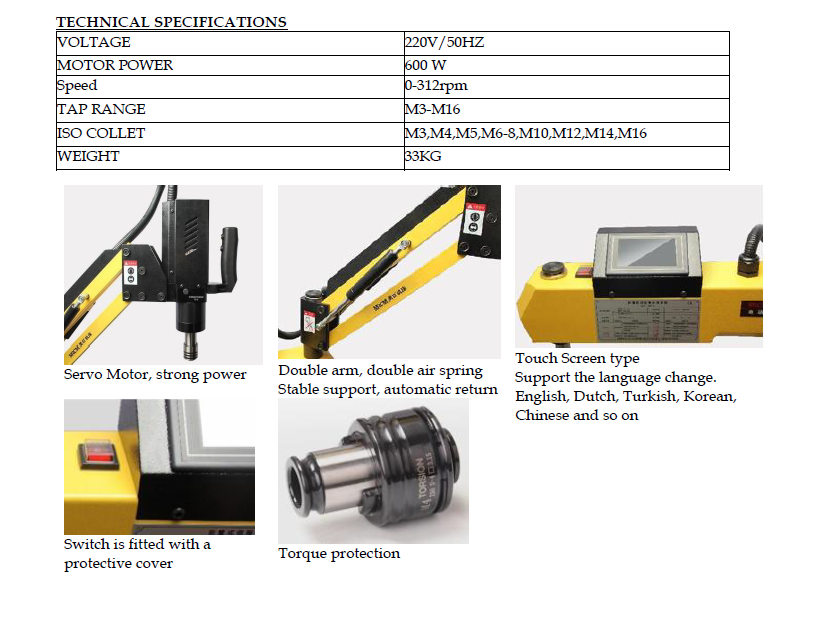
– Adjustable torque limiter / clutch: Prevents tap breakage by stopping feed when a preset torque threshold is reached — especially useful in hard materials or blind holes.
– Variable speed control: Adjust rotation speed according to material type (soft aluminum vs. hardened steel).
Reduced Labor Cost & Physical Strain
– Less manual effort: Operators don’t have to apply force or maintain hand pressure — tapping becomes push‑button or powered.
– Lower operator fatigue: Especially beneficial in repetitive tasks, reducing risk of strain or injury due to prolonged hand work.
Integration & Automation Ready
– Compatible with CNC & workcells: Modern electric tapping systems can be mounted on CNC machines, drilling centers, or robotic arms — enabling fully automated machining lines.
– Flexibility: Easy to program different thread sizes, depths, materials — suitable for shops handling multiple products with varying specs.
Applications:
Automotive & Auto‑Component Manufacturing
– Engine blocks, cylinder heads, gearbox housings, transmission cases — threaded holes for bolts and studs.
– Chassis components, brackets, suspension parts.
– Bulk production of fastener-ready parts for assembly lines — boosting throughput and consistency.
Heavy Machinery & Industrial Equipment Fabrication
– Hydraulic pump housings, gearbox bodies, valve blocks — often require deep, strong threads in alloy steel or cast iron.
Manufacturing & Assembly Lines (Mass Production)**
– High-volume production of flanged components, motor housing, casing where swift and uniform tapping cuts down lead time significantly.
Prototype, Tool & Jig Manufacturing**
– Production of fixtures, jigs, molds, tooling plates requiring accurate threaded holes.
– Rapid prototyping — quick turnaround for thread-ready parts, useful for testing and design iterations.
Custom Fabrication & Small Batch Work**
– Custom projects — where each workpiece may differ. The flexibility of electric tapping machines supports variable thread sizes, materials, and depths without complex re-tooling.
Benefits:
- Consistent Thread Quality & Precision
Electric tapping machines deliver uniform thread depth, pitch, and cleanliness, reducing rework and scrap. This consistency is crucial for assemblies requiring exact tolerances, load‑bearing components, or parts subjected to stress. - Metal Fabrication Workshops & General Engineering
– Flanges, couplings, pipe fittings, metal enclosures, control panels — threaded parts for assembly and assembly-ready fabrication.
– Custom parts and small batch fabrication — flexibility for various thread sizes and materials. - Pipe & Plumbing Industry
– FlANGED pipe ends and connectors requiring threaded bolt holes for secure bolting.
– Valve bodies, pump casings, manifold blocks with threaded ports. - Electrical & Instrumentation Enclosures
– Sheet-metal enclosures, junction boxes, control panel housings needing tapped holes for fasteners.
– Equipment mounting plates, panels, and frames for industrial controls. - Maintenance, Repair & On‑Site Work (MRO)
– Workshops conducting retrofit, repair, or maintenance of machinery often need to retap or add threaded holes — electric tapping machines help accomplish this quickly, with precision, and on-site. - Construction & Structural Fabrication
- Steel beams, structural plates, metal fabrications — for bolted connections.
- – Metal furniture, railing assemblies, structural frameworks requiring threaded fasteners.
Limitations:
- Initial Capital Investment
Electric tapping machines — especially quality ones with torque control, automatic reverse, and adjustable feeds — cost more upfront than manual hand taps or simple power drills. For very small workshops with minimal tapping needs, the cost may be difficult to justify. - Electricity & Infrastructure Dependence
These machines require stable power supply. On remote job sites or in places with frequent power cuts, manual tapping may remain more reliable. Additionally, integration with CNC centers or automation may demand additional infrastructure like fixtures, coolant, chip removal, etc. - Limited to Pre‑Drilled Holes
Electric tapping machines typically assume a pre-drilled and properly sized hole. They do not perform drilling — thus, a drilling operation must precede the tapping, which may involve separate setup or machines. - Not Ideal for Extremely Hard or Exotic Materials without Proper Setup
While electric tapping improves over manual tapping, threading very hard materials (e.g. high-hardened steel, carbide) may still cause tap wear or breakage if parameters are not carefully controlled. Specialized taps and lubrication are needed. - Requires Proper Fixturing & Setup for Accuracy
For consistent results, workpieces must be firmly clamped and perfectly aligned. Without proper fixturing, threads may be skewed, damaged, or incorrectly aligned — more critical in automated setups.
Conclusion:
The Electric Tapping Machine is an indispensable asset in modern metal fabrication and manufacturing — transforming the thread‑cutting process from time‑consuming manual work into a precise, efficient, and high‑throughput operation. Whether your workshop produces threaded housings, flanges, industrial equipment, or custom components, electric tapping delivers advantages in consistency, speed, quality, and scalability that manual methods cannot match.
With features like controlled torque, automatic reverse, adjustable feeds, quick-change tooling, and automation readiness — electric tapping machines fit seamlessly into workshops of all sizes: from small maintenance shops to large-scale production lines. The benefits are clear: reduced labor costs, lower scrap rates, consistent quality, and higher productivity. At the same time, being aware of limitations — need for pre‑drilled holes, proper fixturing, maintenance, initial investment, and skill requirements — helps businesses make informed decisions and implement best practices.
For organizations aiming to meet tight production schedules, maintain high standards, and stay competitive in today’s fast-paced manufacturing environment — investing in electric tapping technology is a smart move. It not only enhances operational efficiency but also improves product quality, reduces human error, and prepares your shop for future automation and scale.
Technical Parameters