
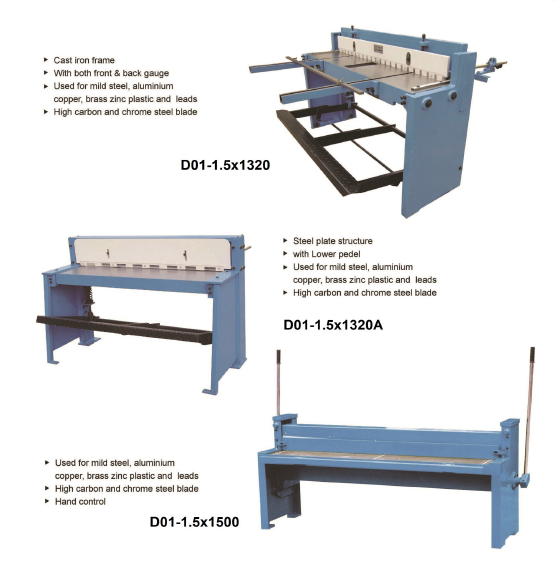
Introduction on Electric & Manual Shearing Machine
In metal fabrication and industrial production, one of the most fundamental operations is cutting sheet metal and plate materials to required sizes and shapes. A shearing machine, whether electric or manual, serves this crucial purpose by performing straight, clean, and accurate cuts across various types of metal sheets. Unlike abrasive cutting methods (such as grinding or sawing), shearing applies a precise slicing force that separates material along a straight line without generating heat‑affected zones or wasted edges.
Metal fabrication has witnessed a massive evolution over the years. Initially, basic hand tools like chisels and manual saws were used to shape and cut metal sheets. However, with increasing industrial demands, traditional methods could no longer keep up with the precision and speed requirements of modern-day production. This is where shearing technology stepped in to bridge the gap between manual labor and mechanical efficiency.
Manual shearing machines were the first advancement — allowing operators to make faster, cleaner cuts with less effort. These machines, operated by foot pedals or hand levers, are still popular in small workshops and maintenance departments due to their portability, simplicity, and low maintenance. However, as demand for higher throughput grew, industries turned to electric shearing machines — powered by motors and designed to handle thicker materials, higher volumes, and more demanding accuracy levels.
Today, both types of shearing machines coexist in the market, serving different segments. Manual versions are ideal for light-duty applications, prototyping, or on-site cutting jobs. Electric models dominate in mass production units where speed, safety, and consistency are non-negotiable.
Customization and Control
One of the underrated advantages of electric shearing machines is their customization capability. Modern systems allow integration with programmable logic controllers (PLC), enabling users to set cut lengths, quantities, and back gauge positions with precision. This brings automation and consistency into everyday tasks — even in medium-scale workshops.
Some models now feature:
– Touchscreen interfaces
– Servo-controlled back gauges
– Safety light curtains and overload protection
– Digital stroke adjustment for different material thicknesses
What is a Shearing Machine?
A Shearing Machine is a metalworking tool used to cut sheet metal, plates, and other flat materials with a straight shear force exerted by a blade or set of blades. The process is often called “shearing” or “knife cutting,” and it works similarly to how scissors cut paper — by applying opposing forces that slice through the material cleanly.
There are two main categories of shearing machines:
1. Manual Shearing Machine – Operated by hand or with mechanical levers.
2. Electric Shearing Machine – Powered by electric motors, suitable for higher capacity and faster production.
Both types are widely used across industries for cutting metal sheets, steel plates, and other materials where smooth and accurate cut edges are required.
Historical Context
Traditionally, metal cutting was performed using basic tools like hack saws or oxy‑fuel torches. These methods were slow, produced rough edges, and required extensive finishing. With industrialization, mechanized cutting tools such as shearing machines emerged to improve efficiency, accuracy, and repeatability.
Today, shearing machines have become essential in sheet metal fabrication, structural steel workshops, heavy machinery production, and construction industries worldwide.
Why to Use?
Accurate & Straight Cuts
Shearing machines produce straight and smooth edges without deformation, making them ideal for follow‑up processes such as bending, welding, or assembly. The cut quality outperforms many alternative methods, especially on thinner sheets.
Faster Processing
Manual shearing machines offer quick cuts for smaller operations, while electric machines enable rapid, repetitive cuts that significantly increase productivity in high‑volume manufacturing.
Versatility
Both electric and manual shearing machines can be used on a wide range of materials — from mild steel and stainless steel to aluminum and non‑ferrous metals — making them versatile across shop environments.
Efficiency in Batch Production
For workshops that must process many sheet pieces into specified widths or shapes, shearing machines maintain consistent cut lengths and profiles. This regularity is essential in batch fabrication.
Safety and Ease of Use
Shearing machines are designed with operator safety in mind. Modern versions include guards, foot pedals, anti‑kickback features, and ergonomic designs, reducing risks compared to improvisational cutting methods.
ELECTRIC SHEARING MACHINE
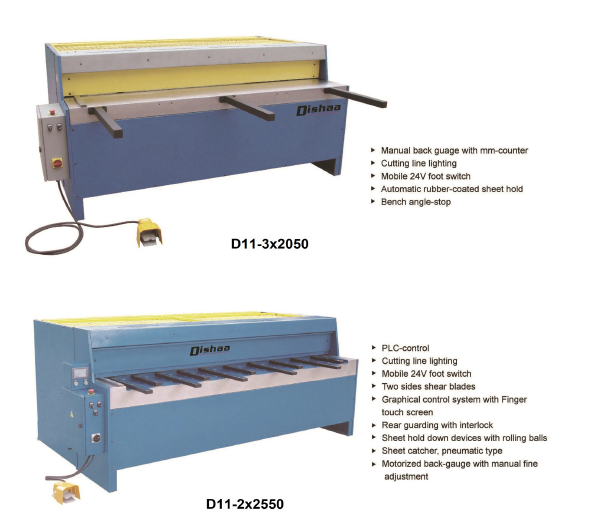
Features:
Precision Blades
High‑grade cutting blades — often heat‑treated or alloy steel — deliver clean cuts and prolonged edge life. Blades are replaceable and adjustable for numerous thicknesses.
Manual Shearing Mechanism
In manual machines, a lever or handle gives mechanical advantage for cutting. These are ideal for smaller shops or lower volume cutting tasks and do not require power.
Electric Motor Drive
Electric shearing machines use powerful motors that enable:
– Higher cutting speed
– Greater cutting force
– Repetitive operations without manual fatigue
Adjustable Back Gauge
Back gauges help position the sheet metal at a precise distance from the cutting line. This ensures consistent cut lengths and reduces material waste.
Foot Pedal Operation
Electric shearing machines often include a foot‑operated switch, allowing hands‑free cutting with better control and improved safety.
Scales and Markings
Integrated measurement scales along the cutting bed help in setting precise cut angles and distances.
Sheet Support Tables
These help support larger workpieces, preventing sagging and improving operator control over long cuts.
Adjustable Cutting Angle & Rake
Some machines offer variable blade rake and cutting angles to optimize for material thickness and type — improving cut quality and reducing the load on blades.
Types Of Shearing Machines:
Although the focus is on Electric & Manual shearing machines, it helps to understand the main types:
✔ Manual Shearing Machines
– Hand‑lever operated
– Ideal for small workshops
– Low initial investment
– Low running costs
– Suitable for lighter materials and thinner sheets
✔ Electric Shearing Machines
– Motor‑driven cutting operation
– Higher production capacity
– Suitable for medium to heavy sheet cutting
– Faster and more efficient
– More safety features
Technical Parameters:
| Model | D11-3x1250 | D11-3x2050 | D11-4x1300 | D11-2x2550 |
|---|---|---|---|---|
| Max.shearing thickness(mm) | 3.0 | 3.0 | 4.0 | 2.0 |
| Max.shearing width(mm) | 1250 | 2050 | 1300 | 2550 |
| Shearing angle | 2° | 2° | 2.4° | 1.6° |
| No. of stroke (per minute) | 30 | 30 | 30 | 30 |
| Motor power(kW) | 3 | 4 | 4 | 4 |
| Back gauge(mm) | 630 | 630 | 630 | 630 |
| Dimension(cm) | 184*103*135 | 266*116*147 | 191*116x145 | 320x116x148 |
| N.W.G.W. | 960/1140 | 1520/1650 | 1320/1520 | 1900/2150 |
Technical Parameters:
| Model | D01-1.0x1000 | D01-1.5x1320 | D01-2x1000 | D01-1.5x1320A | D01-1.5x1500 | D01-1.25x2000 |
|---|---|---|---|---|---|---|
| Width (mm) | 1000 | 1320 | 1000 | 1320 | 1500 | 2000 |
| Max. shearing thickness (mm) | 1.0 | 1.5 | 2.0 | 1.5 | 1.5 | 1.25 |
| Back gauge range (mm) | 0-840 | 0-840 | 0-840 | 0-840 | 0-300 | 0-300 |
| Packing size (cm) | 140x76x115 | 158x76x115 | 140x76x115 | 168x76x115 | 208x76x120 | 258x76x120 |
| N.W.G.W.(kg) | 365/410 | 491/546 | 430/490 | 480/520 | 445/515 | 511/600 |