
POWER PRESS
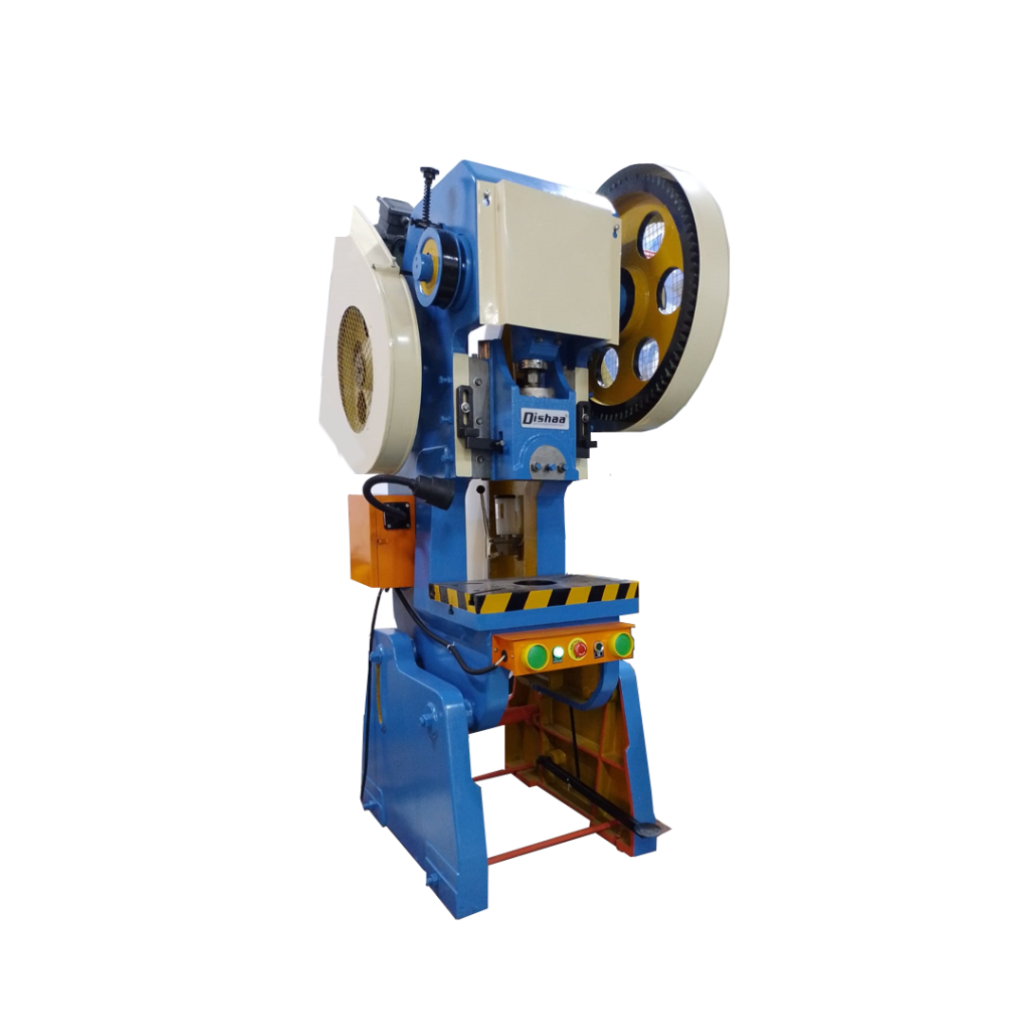
Introduction to Power Press Machine
A power press machine is one of the most essential pieces of equipment used in modern manufacturing and metal-forming industries. It is a versatile mechanical device designed to exert a significant amount of force on metal sheets, enabling operations such as cutting, bending, punching, shaping, and drawing. Unlike manual presses, a power press relies on external power sources—typically mechanical or hydraulic systems—to deliver high-speed and high-precision performance. Because of its efficiency and reliability, it has become a cornerstone in industries such as automotive manufacturing, appliance production, electronics, sheet metal fabrication, and industrial machinery.
The fundamental working principle of a power press machine involves converting rotational motion into linear motion. In a typical mechanical power press, an electric motor drives a flywheel, which stores kinetic energy. This energy is transmitted through gears and a crankshaft to produce a downward force or stroke. Hydraulic power presses, on the other hand, use hydraulic cylinders and fluid pressure to create a controlled and uniform pressing action. Both types offer unique benefits, with mechanical presses known for speed and repeatability, while hydraulic presses excel in flexibility and consistent pressure control.
One of the major advantages of power press machines is their ability to handle mass production tasks with remarkable accuracy. They allow manufacturers to produce identical components in large quantities while maintaining tight tolerances and minimizing material waste. Their automated or semi-automated operation also reduces manual labor, increasing productivity and ensuring worker safety when proper protective devices are used. Many modern power presses come equipped with advanced features such as automatic feeding systems, digital controls, overload protection, and safety guards, further improving efficiency and reducing operational risks.
In summary, a power press machine plays a vital role in shaping the industrial landscape by providing powerful, accurate, and efficient metal-forming solutions. Its combination of speed, versatility, and precision has made it indispensable in manufacturing processes worldwide, supporting industries in producing high-quality components reliably and cost-effectively.
Features:
- Steel plate welding machine, good rigidity, more stable accuracy.
- Crankshaft longitudinal, compact structure, beautiful appearance.
- Electric adjustment of the height of the mould, digital display control height.
- Rectangular block with a lengthened guide, bronze lining board, high guidance accuracy.
- Combined pneumatic friction clutch brake, joint stable, action sensitivity.
- Collapse type safety device, to ensure the safety of the whole machine.
- Slider is high, there is a lifting type balance cylinder, to achieve the balance of the slider bar.
- The slider can be moved with a small movement, emergency stop motion, more secure operation.
- The circuit uses double valve control, the action is nimble, accord with the safety standard of press
Adventages:
- Power press machines operate at high speeds, allowing large quantities of components to be produced in a relatively short time. This improved production rate makes them ideal for mass manufacturing industries.
- These machines deliver consistent and precise operations such as punching, bending, cutting, and forming. The accuracy ensures uniformity across all produced parts, which is essential for industries that require tight tolerances.
- Since most operations are automated or semi-automated, the need for manual effort is significantly reduced. This not only minimizes human fatigue but also lowers labor costs.
- A single power press machine can perform multiple processes—shearing, punching, blanking, drawing, and embossing. This versatility allows manufacturers to use one machine for various applications, improving overall efficiency.
- Power presses are capable of generating large amounts of pressing force, making them suitable for heavy-duty metal forming and shaping tasks. This capability allows the machine to handle thick and tough materials with ease.
- Once the machine is set up, it can repeatedly produce identical parts without variation. This consistency is crucial in industries like automotive and electronics, where uniformity determines product quality.
- Power press machines are built with strong, rigid frames and high-quality mechanical components. With proper maintenance, they offer long-term reliability and can operate continuously under demanding conditions.
- Modern power presses can be integrated with automatic feeders, conveyors, and digital control systems. This improves overall workflow, safety, and production speed.
Applications:
- Suitable for blanking, punching, forming, bending, stretching and other cold stamping process to achieve.
- Widely used in electrical appliances, vehicles, tractors, mining machinery, hardware tools, machinery manufacturing and other industrial areas.
- They are used to cut flat shapes (blanks) from sheet metal, which serve as the starting material for further forming or assembly operations.
- Industries use power presses for deep drawing applications, where metal sheets are stretched into complex shapes such as cups, cans, and automotive body parts.
- The machine is used for straight cutting or shearing of metal sheets with precise edges, making it useful in sheet metal workshops.
- These machines are used for high-precision stamping operations such as minting coins, logo marking, and producing intricate metal components.
- Power presses assist in assembling components by press fitting or riveting, making them useful in automotive and machinery manufacturing.
- The machine helps in making electrical enclosures, switchgear components, metal housings, and small electronic hardware.
- Many household appliance parts—such as washing machine bodies, fans, kitchen equipment, and metal covers—are produced using power presses.
Small tools, hinges, clamps, and metal fittings are made through pressing operations.
Technical Parameters:
| Specification | Units | JB23-16 | JB23-63 | JB23-80 | JB23-100 |
|---|---|---|---|---|---|
| Nominal pressure | KN | 160 | 630 | 800 | 1000 |
| Nominal force stroke | mm | 2 | 4 | 5 | 5 |
| Slider stroke | mm | 50 | 80 | 100 | 100 |
| Number of slider stroke | /min | 140 | 50 | 50 | 40 |
| Maximum die set height | mm | 170 | 250 | 300 | 300 |
| Die set height adjustment | mm | 30 | 50 | 60 | 80 |
| Distance from slider center to frame | mm | 160 | 250 | 260 | 310 |
| Worktable dimension | mm | 320x460 | 420x650 | 470x750 | 570x860 |
| Thickness of the worktable panel | mm | 45 | 70 | 80 | 90 |
| Size of the handle hole (diameter x depth) | mm | cp40x60 | cp50x70 | cp60x80 | cp60x80 |
| Vertical columns distance | mm | 240 | 320 | 300 | 420 |
| Main motor | Model | Y90L-4 | YI32S-4 | YI32S-4 | YI32M-4 |
| Power | KW | 1.5 | 5.5 | 5.5 | |
| Maximum tilting angle of body | ° | 25 | 25 | 20 | 20 |
| Overall dimension (L x W x H) | mm | 1130X830X1890 | 1740X1100X256 | 1765X1265X2560 | 1940X1490X2850 |
| Weight | Kg | 1090 | 3800 | 5015 | 6120 |