
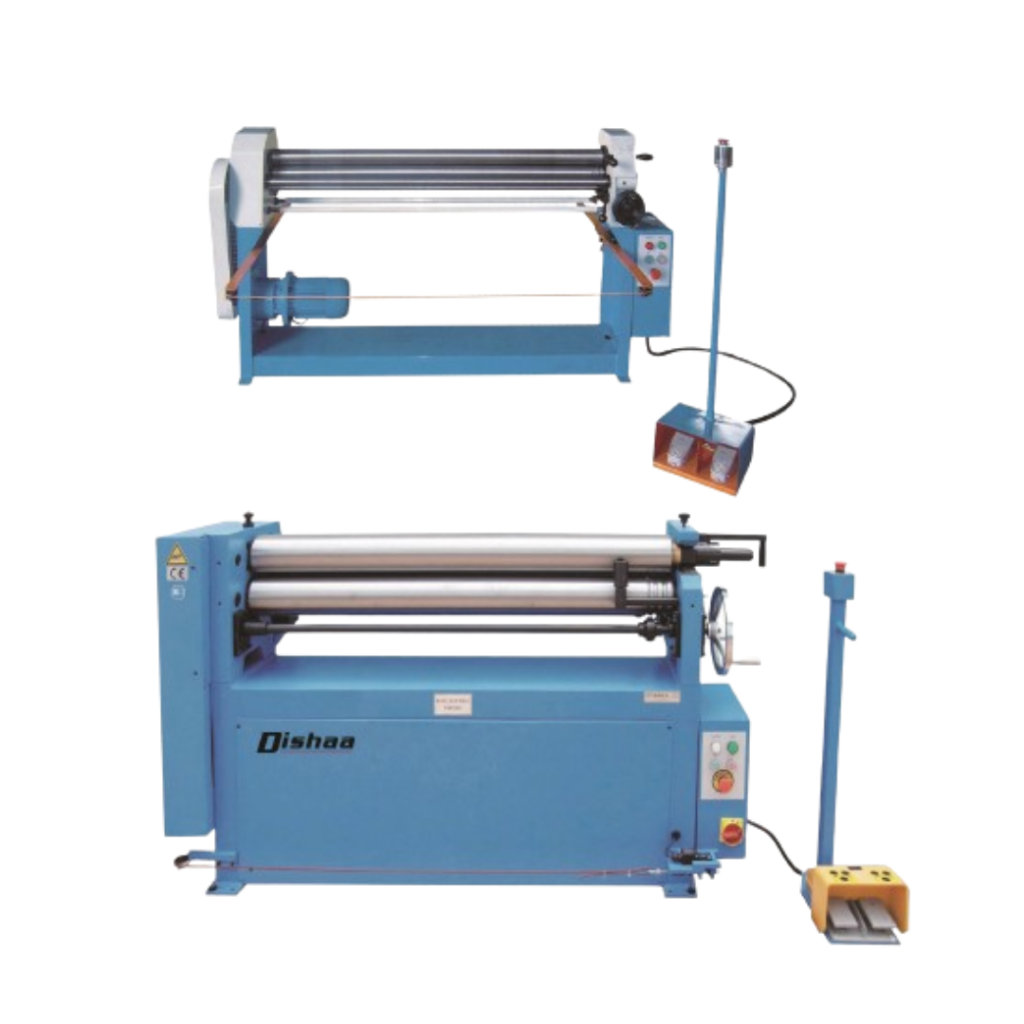
SLIP ROLL MACHINE

Slip roll machine

Introduction:

In the world of metal fabrication and sheet‑metal work, a Slip Roll Machine (also known simply as a “plate rolling machine” or “roll bending machine”) plays a critical role. Whether you are working on light-gauge sheet metal or heavier plates, a slip roll offers a reliable, efficient method to bend, curve, or roll metal into cylindrical, conical, or curved shapes — tasks that are often difficult or impossible with conventional metalworking tools.

A slip roll machine typically consists of three (or sometimes four) rollers: two bottom rollers (which remain fixed or adjustable) and a top roller (which moves up and down). By feeding a flat sheet between these rollers and applying pressure, the machine incrementally bends the metal into a curve or cylinder. With repeated passes, the operator can roll the metal into pipes, tubes, tanks, curved panels, or any shape requiring a smooth radius.

At Dishaa Machinery & Tools, we provide heavy-duty, CE‑certified slip roll machines designed to meet the demands of small workshops, industrial fabrication plants, and custom metalworking shops across the UAE, GCC, and beyond. Our machines are engineered for safety, accuracy, and versatility — whether you need to produce cylindrical tanks, ducts, structural components, or decorative metalwork.

In modern fabrication, where flexibility, precision, and efficient material handling are key, a slip roll machine is more than a convenience — it’s often indispensable. This article delves into the core features, wide-ranging applications, and compelling benefits of using a slip roll machine in today’s metalworking environment, while also offering insights into proper selection, maintenance, and best practices.

How Slip Roll Machines Work

To appreciate the capabilities of a slip roll machine, it’s useful to understand its working mechanism:

1. The Roller Arrangement
– Top Roller (Pinch Roller): This roller presses downward against the metal sheet. Adjusting the vertical position controls the bending radius.

2. Feeding and Bending
– The operator inserts the flat metal sheet at one end.
– By adjusting the pinch roller, pressure is applied.
– The machine is then manually or motor-driven to roll the sheet through.
– With each pass, the metal curves more, until the desired radius or cylinder is achieved.

3. Multiple Passes for Tight Curvature
– Unlike hydraulic presses which apply one strong bend, slip rolling gradually curves the sheet across several passes. This results in smoother bends, less stress on the metal, and greater control.

4. Optional Back‑Up Plate or Slip Plate
– Some heavy-duty slip roll machines include a back or slip plate to support the curved sheet as it exits, preventing collapse or deformation, especially on longer or heavier sheets.

Features:

1. Adjustable Roller Position and “Pinch” Control
– Precision crank or hydraulic-adjustment for the top roller allows for variable curvature and cylinder diameters.
– Fine adjustment ensures accurate bending, reducing scrap and rework.

2. Heavy-Duty Construction and Robust Frame
– Made from stress-relieved cast steel or heavy-duty welded steel: ensures frame rigidity even under high bending forces.
– Keeps rollers parallel and aligned, preventing distortion and ensuring uniform bend radius.

3. Drive Mechanism — Manual, Electric, or Hydraulic
– Manual Drive: Hand-wheels or lever-cranks; suitable for light sheet metal or low-volume work.
– Electric Drive: Motorized bottom rollers for smoother, consistent rolling — ideal for medium production loads.
– Hydraulic Assist (on heavy-duty models): For thicker plates, offering greater force with minimal operator effort.

4. Roller Surface Quality & Die Hardening
– High-quality, hardened rollers reduce wear, ensure longevity, and minimize marks/scratches on the metal surface.

5. Safety Guards and Locking Systems
– Protective covers and guards over rollers help prevent accidents.
– Locking mechanisms secure the upper roller during non-operation or manual loading/unloading.

6. Slip Plate / Adjustable Exit Support
– Prevents deformation or collapse of curved workpieces at exit end.
– Especially useful when rolling large-diameter cylinders or tanks.

7. Multi‑Roll Configuration (4‑Roll or 3‑Roll Designs)
– 3‑Roll models: Suitable for standard curvature and sheet bending.
– 4‑Roll models: Offers more versatility — easier to roll tighter radii, improved control, and often driven rolls for smoother throughput.

8. Versatility of Material Types and Thickness Range
– Designed to handle various metals: mild steel, stainless steel, aluminum, copper, etc.
– Thickness capacity varies by model — from thin sheets (e.g., 0.8 mm) to heavier plates (e.g., 4–6 mm or more), depending on machine rating.

9. Rapid Setup & Adjustability
– Quick adjustments to roller spacing and pressure allow operators to transition between jobs with minimal downtime.
– Reduces lead time in production scheduling.

Applications:

1. Sheet Metal Fabrication & Envelope Work
– Cylindrical Products: Manufacturing of cylindrical tanks, drums, barrels, silos.
– Conical Hoppers & Funnels: Easily formed by incrementally reducing roller diameter.
– Ducts & Ventilation Equipment: HVAC ducting, curved ducts, air-handling units, aluminum or galvanized sheet duct fabrication.
– Metal Furniture & Fixtures: Curved frames, decorative panels, barrel-shaped furniture components.

2. Structural and Industrial Fabrication
– Industrial Tanks & Pressure Vessels: Rolling of metal plates to form cylindrical bodies before welding and assembly.
– Industrial Cylinders & Casings: For heavy equipment, compressors, hydraulic cylinders, and motor housings.
– Pipe & Tube Pre‑Forming: For roll-bending sheet before welding into pipes or ducts.

4. Automotive & Transportation Industry
– Vehicle Body Panels: Curved panels for vans, buses, trucks, trailers.
– Exhaust Systems: Rolling sheet metal for custom exhaust housings or silencers.
– Chassis & Structural Components: Preforming components before welding or assembly.

5. HVAC, Air‑conditioning & Ventilation Systems
– Ductwork: Circular and oval duct manufacturing.
– Air Handling Units & Fans: Sheet forming for fan housings and air ducts.

6. Marine & Shipbuilding Sector
– Boat Hulls and Sections: Rolling thin steel or aluminum plates for hull curves, bulkheads, and decks.
– Exhaust Ducts & Piping: Rolling components for marine ventilation and exhaust systems.

7. Heavy Equipment and Agricultural Machinery
– Equipment Casings: Cylindrical or curved bodies for pumps, compressors, and hydraulic units.
– Construction Machines: Roll-bent body panels for dump trucks, containers, harvesters, and storage tanks. 

Choosing the Right Slip Roll Machine – What to Consider  

1. Material Type & Thickness Capacity:
– Know the metal types (mild steel, stainless, aluminum) and thickness range you plan to roll.
– Choose a machine with roller strength and drive power to handle the heaviest expected thickness.

2. Roller Diameter & Length:
– Larger roller diameters help with tighter bends and reduce surface marking on metal.
– Ensure roller length matches your maximum sheet width requirement.

3. Drive Mechanism (Manual, Electric, Hydraulic):
– Light sheet fabrication may only need manual or electric rolls.

4. Space & Workflow Optimization
– Floor‑standing or bench models fit into smaller workshops.
– One machine can handle multiple fabrication steps — cutting, rolling, forming — optimizing shop layout and workflow.

5. Improved Safety & Operator Comfort
– Controlled, mechanical process reduces strain on workers compared with hammering, bending, or manual rolling.
– Safety guards and stable frame decrease risk of accidents, especially when rolling heavy sheets.

6. Faster Turnaround & Higher Productivity
– Hydraulic or motor-driven rollers speed up the process significantly compared with manual rolling.
– Quick setup and roll cycles mean faster job completion, better throughput — ideal for production runs or contract fabrication.


Technical Parameters:

Model Max. rolling thickness (mm) Max. rolling width (mm) Dia. of roller (mm) Motor power (kW) Dimension (cm) N.W./G.W. (kg)
DMER-1300x1.5 1.5 1300 75 0.75 180x65x110 280/340
DMER-1300x2.5 2.5 1300 90 1.5 200x72x120 540/600
DMER-1300x4.5 4.5 1300 120 2.2 200x76x127 750/830
DMER-1550x3.5 3.5 1550 120 2.2 222x76x127 790/890
DMER-2020x3.0 3.0 2020 127 4.0 270x87x130 1100/1200