
SURFACE GRINDER
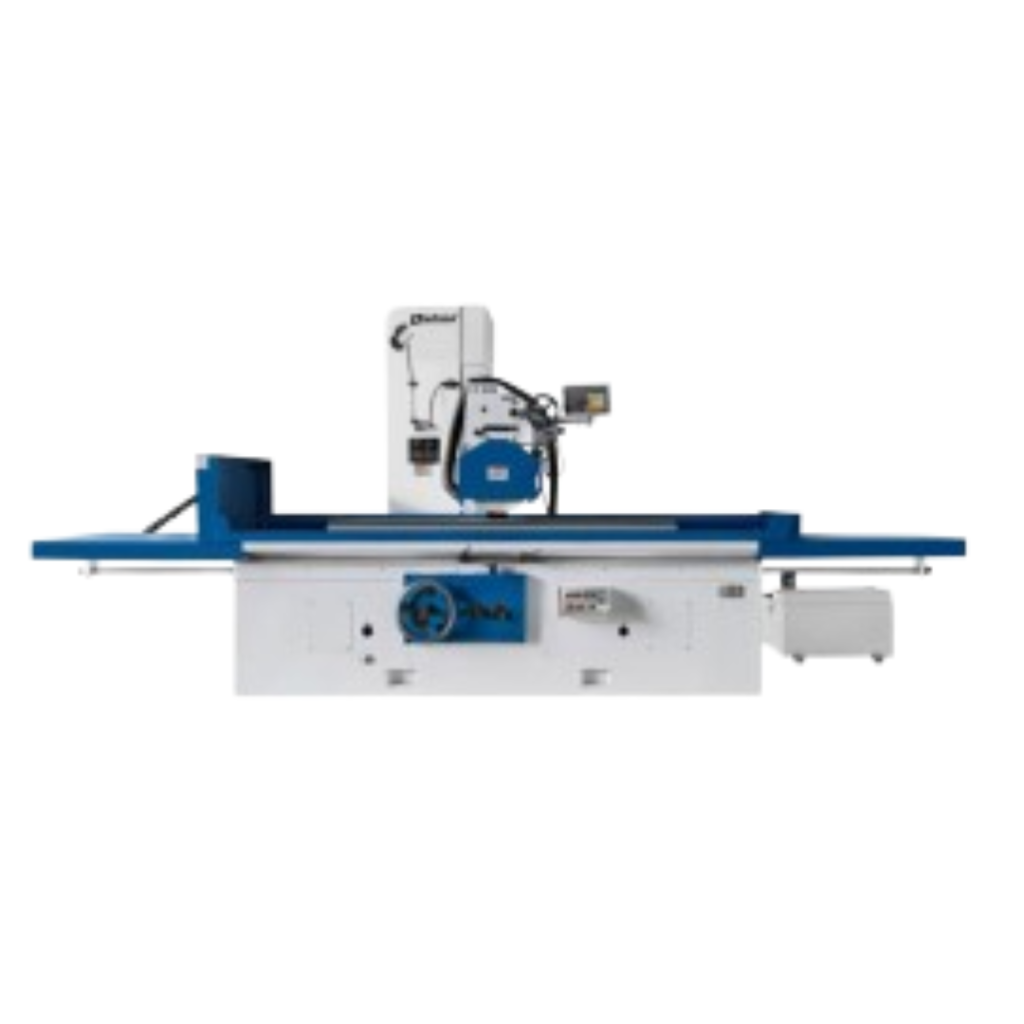
Features:
Historically, before the advent of mass‑production machinery and CNC milling, machinists relied on manual hand‑filing, surface plates and scraping, or primitive grinder setups to flatten and finish parts — methods that were time‑consuming, labor‑intensive, inconsistent, and unsuitable for volume production. The introduction of the surface grinder transformed this aspect of manufacturing, enabling precise, repeatable, high‑quality surface finishing at speed, with far less manual effort. Over decades, surface grinders evolved from simple bench‑mounted belt or disc grinders into fully equipped precision machines with adjustable tables, magnetic or vacuum chucks, coolant systems, wheel balancing, and fine feed controls — bridging the gap between traditional craftsmanship and modern industrial efficiency.
In metalworking, fabrication, and tool‑making workshops, achieving a truly flat, smooth, and precise surface across flat metal components is often a critical requirement. Whether you’re manufacturing machine parts, molds, dies, precision tools, or finished metal plates, the flatness, surface finish, and dimensional accuracy can have a major impact on the quality, fit, and performance of end products. This is where a surface grinder machine becomes indispensable.
A surface grinder is a bench or floor‑mounted machine designed specifically to produce very smooth and precise flat surfaces on workpieces, primarily metal. Using a rotating abrasive wheel — typically bonded with aluminum oxide, silicon carbide, CBN (cubic boron nitride), or diamond — the machine removes small amounts of material from the surface of a workpiece via controlled grinding action, under coolant or lubrication to avoid overheating and to maintain surface integrity. The process is fundamentally different from cutting, milling, or turning; it’s a grinding action, ideal for finishing, achieving tolerances down to microns, and flattening surfaces that need perfect planarit.
In today’s competitive markets — from aerospace components to automotive parts, from mold‑making shops to heavy‑duty fabrication units — the demand for consistent flatness, tight tolerances, and high surface finish is higher than ever. Having an in‑house surface grinder ensures that you can produce parts with superior finish and precision without outsourcing, reduce lead times, and maintain full control over quality. For small workshops, a compact surface grinder provides the ability to complete finishing tasks on site; for larger factories, heavy-duty surface grinders serve as critical stations to ensure that parts meet exact specifications before further processing or assembly.
This comprehensive guide delves into the core aspects of surface grinder machines: why to use them, what features to look for, where they’re applied, the tangible benefits, and the limitations you should be aware of. Whether you are evaluating your first grinder, comparing options for a workshop upgrade, or just want a deeper understanding before investing — this article aims to equip you with the knowledge to make an informed decision.
Why to choose?
- Ultimate Flatness and Surface Accuracy
– Micron-level tolerance: Surface grinders are capable of achieving extremely tight tolerances — often within a few microns — guaranteeing flatness. Milling or cutting cannot generally match this level of finish.
– Planar consistency: For parts that require perfect mating surfaces, sealing faces, or precision assembly, flatness across the entire face is critical. A surface grinder ensures this consistency. - Superior Surface Finish (Mirror or Matte as Needed)
– Smooth finish: The abrasive wheel leaves a smooth, finely ground surface, often needing no further finishing or polishing.
– Control over finish texture: By selecting wheel type (coarse, fine, CBN, diamond) and grit, you control surface roughness — from rough grind for flattening to fine-grit for mirror finish. - Precision Rework, Remanufacturing, and Corrections
– Resurfacing worn parts: Old or worn machine parts, castings, flanges, or valves can be resurfaced accurately, restoring flatness and functionality without full replacement.
– Correcting machining errors: If parts were milled imperfectly or warping occurred, surface grinding offers a last‑mile correction for critical surfaces. - Efficiency and Time Savings for High-Quality Finish
– Faster than manual finishing: Grinding removes material quickly and evenly, far faster than filing, hand-scraping, or manual polishing.
– Consistent output across multiple parts: For batch production or repeated parts, surface grinding ensures each part meets the same flatness and finish standards — critical for quality control and interchangeable part manufacturing. - Workflow Integration & Versatility
– Final finishing station: Surface grinders serve as final quality‑check stations before assembly or further processing — integral in quality‑critical industries (mold making, die casting, engine components, precision tools).
– Small to large workshops: From compact bench grinders for small parts to large floor-standing grinders for industrial plates and castings — surface grinding fits many scales of operation.
Features:
- Powerful Abrasive Grinding Wheel & Wheel Guard Assembly
– Various wheel types available: Aluminum oxide, silicon carbide, CBN (cubic boron nitride), diamond wheels — allowing processing of soft steel to hardened alloys.
– Wheel balancing & dressing system: Grounds the wheel to true, ensures consistent cutting, reduces chatter and improves surface finish.
– Wheel guard and enclosure: Protects operator from sparks, dust, and debris during operation — essential for safety compliance. - Magnetic or Vacuum Chuck / Work Holding Table
– Magnetic chuck (for ferrous materials): Provides firm, uniform hold-down without mechanical clamps — ideal for flat parts.
– Vacuum or mechanical fixtures (for non-ferrous or irregular parts): Enables holding of aluminum, brass, plastics, or odd shapes.
– Adjustable table travel (X-Y movement) and precise cross-feed: Allows controlled, incremental passes for uniform surface removal. - Linear Guideways / Precision Slideways with Fine Feed Control
– Smooth, backlash-free table movement: Ensures uniform grinding passes without skips or chatter marks.
– Fine feed adjustments / hand-wheel or power-feed control: Allows precise control of material removal per pass — critical for tolerance control. - Digital Readout (DRO) or Calibrated Scales (Optional but Valuable)
– Depth and table-travel readout: Enables precise measurement of material removal and easy repeatability across multiple parts.
– Preset stops / micrometer adjustment: Facilitates high repeatability and control in serial production or fine finishing work. - Large Working Surface and Table Capacity
– Spacious table size and load-bearing capacity: Capable of handling plates, castings, large machine parts, and heavy workpieces.
– High load capacity chucks or fixtures: Supports heavy materials without deflection — crucial for maintaining flatness on large surfaces. - Versatile Wheel & Setup Options
– Interchangeable wheels (grit size, material): Allows switching between rough grinding (for material removal) and fine finishing (for smooth surfaces).
– Dressing tools: To dress and true the wheel quickly, restore balance, and maintain consistent grinding performance. - Compact Bench‑Top to Heavy‑Duty Floor Models
– Compact models: Ideal for small workshops and precision jobs (tools, gauges, small parts).
– Heavy-duty floor models / double‑column grinders: Suitable for large plates, molds, heavy castings, and industrial-scale operations — offering flexibility across operations.
Applications:
- Tool & Die Making and Mold Manufacturing
– Finishing mold plates and cores: Grinding ensures flatness and surface finish necessary for high-quality injection molds.
– Tool faces, dies, punches, and precision tooling parts: Surface grinding ensures accurate fit, flatness, and correct tolerances required for tool life and product consistency. - Machine Component Manufacturing & Engineering Shops
– Machined parts finishing: After milling or turning, surface grinding can bring surfaces to exact flatness for assembly or further processing.
– Flanges, valve bodies, pump housings, bearing surfaces: Grinding ensures flat faces for proper sealing and assembly, especially critical in hydraulic or pressure equipment. - Maintenance, Repair & Overhaul Workshops (MRO)
– Resurfacing worn machine beds, flanges, guide surfaces: Instead of full replacement, surface grinding restores parts to flatness, extending lifecycle.
– Refurbishing old castings, worn surfaces, and parts to new‑part tolerances: Useful for cost-effective repair and refurbishment operations. - Precision Metal Shops & Custom Fabrication Workshops
– Small parts, jigs, fixtures, gauge plates, tool plates: Grinding ensures high accuracy and flatness — essential for accurate assembly and measurement applications.
– Custom parts requiring high flatness or surface finish: For prototype development, custom fabrication, or small-batch runs where accuracy matters. - Manufacturing OEMs (Original Equipment Manufacturers)
– Production of flat components, assemblies, machine parts: Surface grinding as final finishing station before assembly ensures consistency across components. - Construction & Structural Fabrication
– Metal plates, base plates, machine beds, structural components with precise flat surfaces: Grinding helps in ensuring perfectly flat base surfaces for assemblies or structural alignment. - Research, Development & Prototype Workshops
– Custom prototypes, test plates, experimental components: Surface grinding enables finishing and accurate dimensions even for one‑offs or test pieces. - Educational Institutions & Training Facilities
– Teaching surface finishing, grinding techniques, accurate measurement, and flatness standards: Students and apprentices learn precision machining practices. - Tool Room, Gauge & Calibration Labs
– Gauge blocks, calibration plates, precision measuring surfaces: Surface grinder ensures flatness and finish necessary for precision measurement standards.
Benefits:
- Exceptional Surface Finish & Flatness
– Precision finish: Achieves flatness and surface smoothness beyond what mills or cutters can deliver — ideal for sealing surfaces, mating faces, tool beds, and precision components.
– Tight tolerances: Capable of micron-level tolerances — critical for high-precision industries like molds, aerospace, and tooling. - Versatility Across Materials & Part Types
– Works on a wide variety of materials — mild steel, alloy steel, cast iron, stainless steel, aluminum, non‑ferrous metals, and some composites with proper wheel selection.
– Handles different part sizes — from small tool components to large castings and plates. - Increased Productivity & Consistent Quality
– Faster finishing compared to manual methods: Grinding removes material quickly and uniformly, reducing operator time and finishing workload.
– Repeatable results for batch production: With precise table travel and fixture setups, identical parts can be ground to the same specification repeatedly. - Cost Savings & Reduced Scrap
– Minimized waste: Controlled material removal prevents excessive metal loss — especially important for high-cost materials. - Enhanced Safety Compared to Manual Grinding or Filing
– Proper wheel guards, coolant systems, and enclosed operations reduce risks of sparks, overheating, and operator injury; safer than manual grinding or torch-based cutting. - Quality Assurance & Standardization
– Enables workshop to maintain consistent quality across batches, meet tight tolerances, and ensure reliable assembly and finished product performance.
Limitations:
- Initial Capital Investment & Floor Space Requirement
– Cost: High-quality surface grinders, especially large floor models with chucks and coolant systems, are expensive compared to basic milling or manual tools.
– Foundation & installation: Heavy machines require stable foundation, proper leveling, and sometimes workshop reinforcement. - Consumables and Maintenance Costs
– Grinding wheels: Abrasive wheels wear and need periodic replacement; premium wheels (CBN, diamond) add to consumable costs.
– Coolant and filtration system: Regular maintenance, fluid changes, and waste disposal required; neglect can lead to poor performance or surface finish issues.
– Wheel dressing equipment: Need for dressers and balancing gear — adds complexity and maintenance overhead. - Limited Material Removal / Slow for Bulk Stock Removal
– Surface grinding is ideal for finishing or precise flatness, but not for heavy material removal or shaping — for large stock removal, milling or cutting is still necessary.
– Removing large amounts of material via grinding is time-consuming and inefficient; not suited for rough machining. - Workpiece Size and Shape Limitations
– Limitations on table size, chuck capacity, and fixture type may prevent handling very large or irregularly shaped parts.
– For very large castings or irregular geometries, specialized fixtures or custom setups may be needed — increasing complexity. - Skill and Setup Requirements
– Proper setup (wheel balancing, table alignment, fixture setup, coolant management) requires skilled operators — not fully plug-and-play.
– Incorrect use may cause surface burn, overheating, or damage to workpiece — especially critical for precision or hardened parts.
Conclusion:
A surface grinder machine is far more than a simple shop accessory — it is a cornerstone of precision metalworking, finishing, and quality control. Whether you run a small tool shop, a maintenance workshop, a heavy manufacturing plant, or a mold‑making facility, surface grinding provides a unique capability: the ability to achieve flatness, surface finish, and tolerance levels that are difficult or impossible with conventional cutting or milling.
By delivering exceptional surface quality, precise flatness, and repeatable results — and doing so efficiently, safely, and with versatility — a surface grinder pays for itself many times over. It reduces scrap, rework, external finishing costs, and lead times. It adds value in-house, improves control over quality, and ensures that parts meet exacting standards required in high‑precision industries such as automotive, aerospace, tooling, hydraulic equipment, and mold manufacturing.
At the same time, it is important to be aware of the limitations: investment cost, maintenance requirements, consumable costs, and suitability depending on part size, material, and job type. But for many workshops and manufacturing units, the advantages outweigh the drawbacks — especially when surface grinding is implemented properly, maintained regularly, and used with correct wheel selection, coolant, and operator training.
If you are evaluating adding a surface grinder to your workshop, consider your current and future workloads, part requirements, precision tolerances, and material types. Choose a machine with appropriate bed size, wheel options, coolant system, and table capacity — and invest in proper maintenance infrastructure. With the right setup, a surface grinder becomes an invaluable asset that boosts quality, productivity, and profitability.
Technical Parameters:
| SPECIFICATIONS | Units | DM7163 /1250 | DM7163 /1600 | DM7163 /2000 | |
|---|---|---|---|---|---|
| Table size (L*W) | mm | 1250*630 | 1600*630 | 2000*630 | |
| Max. Longitudinal movement of worktable | mm | 1350 | 1700 | 2100 | |
| Max. Distance from the spindle centerline to the worktable | mm | 880 | 880 | 880 | |
| Max. Cross movement of grinding head | mm | 700 | 700 | 700 | |
| Max. Vertical movement of grinding head | mm | 600 | 600 | 600 | |
| Vertical movement of the grinding head by hand wheel | Every lattice | mm | 0.01 | 0.01 | 0.01 |
| Each turn | mm | 1 | 1 | 1 | |
| Rapid lifting motor | Power | KW | 0.55 | 0.55 | 0.55 |
| Speed | r/min | 1440 | 1440 | 1440 | |
| T-slot of table | mm*n | 18*3 | 18*3 | 18*3 | |
| Table rapid move speed | m/min | 3-22 | 3-22 | 3-22 | |
| Auto feeder speed of table front and back (Stepless) | m/min | 0.6-10 | 0.6-10 | 0.6-10 | |
| Grinding wheel size (L*D*W) | mm | 400*127*40 | 400*127*40 | 400*127*40 | |
| Speed of grinding wheel | r/min | 1440 | 1440 | 1440 | |
| Power of spindle motor | KW | 7.5 | 7.5 | 11 | |
| Power of oil pump motor | KW | 4 | 5.5 | 5.5 | |
| Processing accuracy | mm | 0.005/300 | 0.005/300 | 0.005/300 | |
| Surface roughness | um | Ra : 0.63 | Ra : 0.63 | Ra : 0.63 | |
| Machine weight | kg | 5000 | 6800 | 7500 | |
| Overall dimension(L*W*H) | mm | 3700*2000*2450 | 4800*2000*2450 | 5800*2100*2450 |