
VERTICAL DRILLING
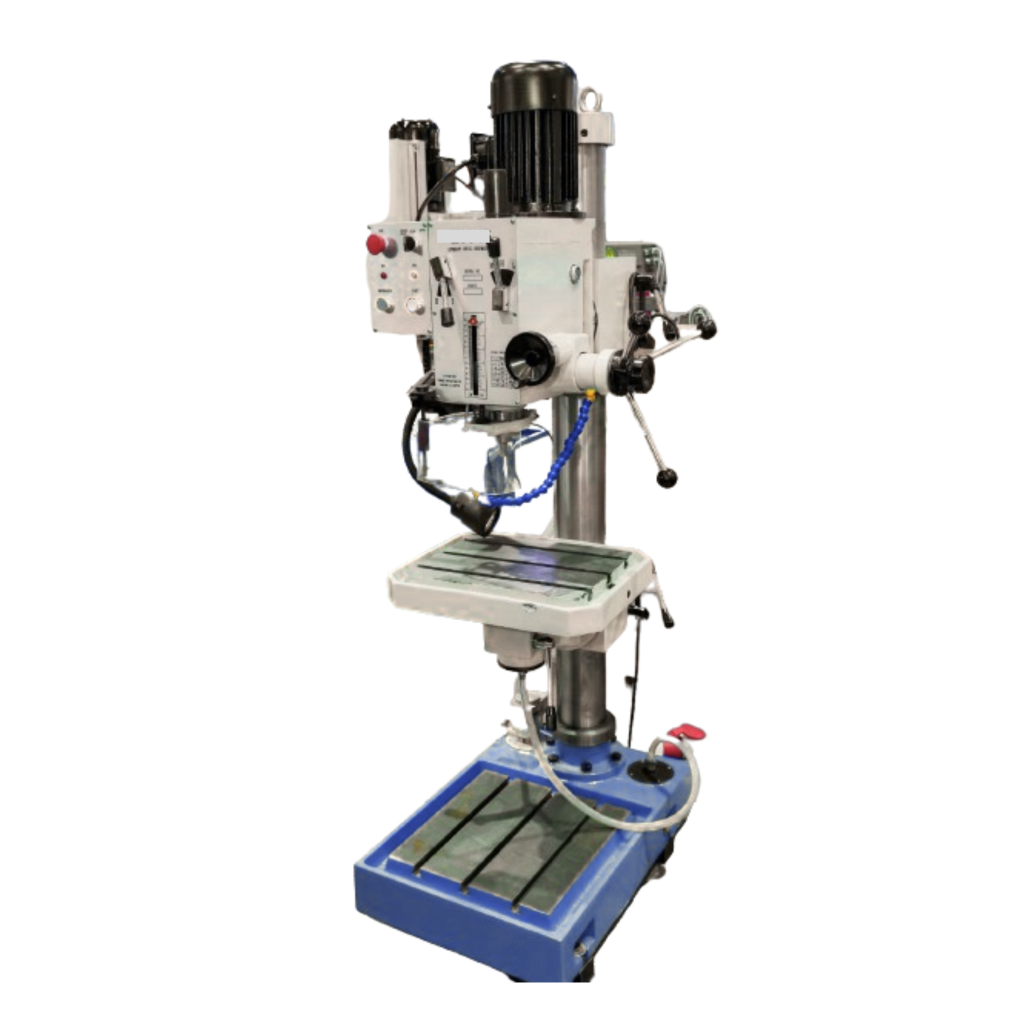
Introduction:
A Vertical Drilling Machine, also known as a pillar drilling or upright drilling machine, is one of the most commonly used types of drilling machines in manufacturing and workshops. It is primarily used for drilling, reaming, tapping, and counterboring holes in solid materials such as metal, wood, and plastic.
As the name suggests, the machine operates with the spindle positioned vertically, allowing the cutting tool (drill bit) to be lowered in a straight, vertical path onto the workpiece. The design of the vertical drill makes it easy to work on small to medium-sized components with high precision and repeatability.
Vertical drilling machines are highly favored in industries due to their simple design, operational stability, and ease of use. These machines can be either bench-mounted for smaller operations or floor-mounted (pillar type) for larger, heavier work. Modern vertical drills come with variable speed controls, digital readouts, coolant systems, and safety features, enhancing their performance and user-friendliness.
Whether in metal fabrication, mechanical workshops, educational labs, or manufacturing lines, vertical drilling machines have become indispensable tools that contribute to consistent production quality and efficient workflow.
Features:
1. Vertical Spindle Movement: Allows precise, perpendicular drilling with minimal deviation.
2. Adjustable Table Height: Enables working on various sizes of components by raising or lowering the table.
3. Speed Control: Variable speed options for different material hardness and drilling depths.
4. Depth Stop Mechanism: Ensures consistent hole depth in batch operations.
5. Coolant System: Prevents overheating during heavy-duty drilling.
6. Digital Readout: For accurate monitoring of speed and depth (in advanced models).
Applications:
Vertical drilling machines find applications across a wide range of industries due to their adaptability and precision:
– Metal Fabrication: Drilling precise holes in steel, aluminum, and iron components.
– Woodworking: Making dowel holes and joinery components.
– Automobile Industry: Engine block and chassis component drilling.
– Electrical & Electronics: PCB and component casing drilling.
– Construction Equipment: Brackets, frames, and structural metal parts.
– Educational Institutions: Used in technical training and mechanical labs.
– Tool Room Operations: General-purpose drilling, tapping, and boring.
Benefits:
- Precision and Accuracy: Consistent hole depth and alignment.
- Ease of Operation: Simple setup and operation, ideal for beginners and professionals.
- Versatile Use: Suitable for various materials and drilling operations.
- High Repeatability: Excellent for batch production where identical holes are needed. Affordable Maintenance: Fewer moving parts mean reduced wear and easy maintenance.
- Compact Design: Takes up less floor space compared to radial drills.
- Scalable: Available in small benchtop models to heavy-duty industrial models.
- Durability: Long service life when properly maintained.
Limitations:
1. Limited Movement: The spindle is fixed vertically, which restricts angular drilling.
2. Manual Workpiece Movement: Requires the operator to position the component manually.
3. Not Ideal for Large Workpieces: Smaller table size limits use with oversized materials.
4. Single Spindle Operation: Cannot perform multi-hole drilling simultaneously.
5. Lower Automation: Less suitable for high-volume automated production without CNC upgrades.
Conclusion:
The Vertical Drilling Machine stands out as a reliable and essential machine for any workshop, combining accuracy, strength, and ease of use. Its widespread application in industrial and educational environments is a testament to its effectiveness. For businesses looking to achieve precision drilling with minimal investment, vertical drills remain a top choice.
Technical Parameters:
| SPECIFICATIONS | Units | DVD5025B | DVD5025 | DVD5030A | DVD5035A |
|---|---|---|---|---|---|
| Max.drilling dia. | mm | 25 | 25 | 30 | 35 |
| Diameter of column | mm | 100 | 100 | 120 | 140 |
| Spindle travel | mm | 150 | 150 | 135 | 160 |
| Distance between spindle nose and table surface | mm | - | 630 | 550 | 590 |
| Distance between spindle nose and stand table | mm | 550 | 1670 | 1100 | 1150 |
| Distance from spindle axis to column surface | mm | 225 | 225 | 320 | 330 |
| Spindle taper | - | MT3 | MT3 | MT4 | MT4 |
| Spindle speed range | rpm | 100-2900 | 100-2900 | 125-3030 | 125-3030 |
| Spindle speeds steps | - | 8 | 8 | 12 | 12 |
| Spindle feed | mm/r | 0.07-0.40 | 0.07-0.40 | 0.1-0.3 | 0.1-0.3 |
| Spindle feed steps | - | 4 | 3 | 3 | 3 |
| Table size | mm | 440 | - | 500*420 | 500*440 |
| Table travel | mm | 290*140 | 560 | 520 | 560 |
| Stand table size | mm | 690*500 | 690*500 | 645*455 | 645*455 |
| Main motor power | kw | 0.75/1.1 | 0.75/1.1 | 1.1/1.5 | 1.1/1.5 |
| Coolant motor power | w | 40 | 40 | 40 | 40 |
| Machine weight | kg | 235 | 300 | 410 | 430 |
| Overall dimension | mm | 780*520*1170 | 700*560*1820 | 875*510*2100 | 875*510*2150 |