
CNC EDM WIRE CUTTING MACHINE
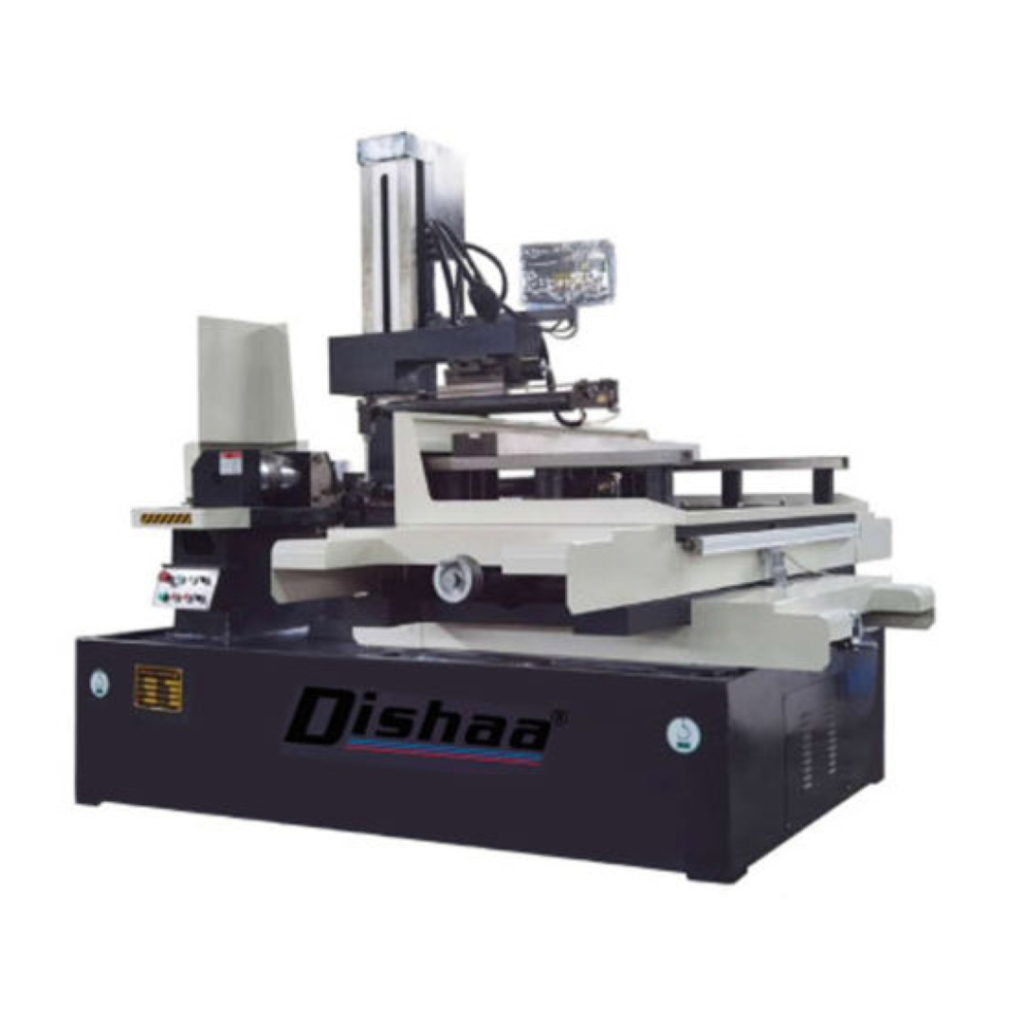
Introduction:
In an era where precision, repeatability, and performance are non‑negotiable, the CNC EDM (Electrical Discharge Machining) Wire Cutting Machine stands as a benchmark in modern manufacturing. Combining smart automation with the power of spark erosion, this machine transforms the way manufacturers, tool makers, and metalworkers handle complex, high‑tolerance parts.
Moreover, CNC edm wire cutting machine offers ultra-fine kerf width, minimal material loss, and burr‑free finishes, which mean lower wastage and reduced requirement for post‑processing. For manufacturers in competitive markets, this translates into higher throughput, lower waste costs, and consistent quality yields. As demand surges for complex, lightweight, and high‑strength parts, the CNC EDM wire cutting machine becomes not just a convenience — but an indispensable asset.
At Dishaa Machinery & Tools, we take pride in offering CE‑certified, heavy-duty CNC EDM wire-cutting systems built for reliability, accuracy, and high uptime. Backed by robust engineering, intuitive CNC control, and comprehensive after-sales support, our machines meet the needs of modern precision workshops and high-performance manufacturing units across the UAE, GCC, and beyond.
Another key benefit is the clean, burr-free finish wire EDM wire cutting provides, which significantly reduces post-processing time. For components that require immediate assembly or precision fit, this is an invaluable advantage. In industries where quality and finish are non-negotiable, like implant manufacturing or precision mold tooling, this advantage translates into both time savings and improved final product integrity.
As manufacturing shifts toward Industry 4.0, CNC EDM wire cutting machines play a vital role in smart manufacturing environments. Integration with CAD/CAM software, remote programming, and intelligent monitoring systems means operators can manage high-performance production lines with reduced manual intervention. Energy-efficient models and automated wire threading systems further enhance the operational productivity of these machines.
With a growing emphasis on cost-effectiveness, efficiency, and zero-defect output, CNC EDM wire cutting continues to gain popularity across the globe. Whether you’re a small-scale workshop or a large industrial manufacturer, investing in a CNC wire EDM machine is a strategic move toward achieving precision, productivity, and profitability.
Why to use:
Machining Hard and Exotic Metals: Materials like hardened tool steel, titanium, high-alloy stainless steel, tungsten carbide — nearly impossible for conventional machining — can be cut with CNC EDM.
Unlike conventional cutting or machining methods that rely on physical contact between a cutting tool and the workpiece — which can introduce mechanical stress, heat deformation, or limitations based on material hardness — EDM works using controlled electrical discharges (sparks). A thin, electrically charged wire (commonly brass or molybdenum) moves along a programmed path while submerged in dielectric fluid, eroding material bit by bit with micron‑level accuracy. This non‑contact process allows machining on extremely hard electrolytic steel, tool steel, tungsten carbide, titanium alloys, and other exotic metals — materials that are otherwise challenging or nearly impossible with conventional milling or turning.
With CNC (Computer Numerical Control) integration, wire‑cutting EDM becomes fully automated and programmable. Engineers can upload specialized designs, from simple contours to intricate 2D and 3D profiles, and the machine executes cuts with minimal human intervention. This is particularly critical in industries such as aerospace, medical implants, tool & die manufacturing, automotive components, and high‑precision engineering — where tight tolerances, consistent repeatability, and surface finishing are paramount.
Features:
Roller rail for X/Y axis, also called hard rail (V Rail). With ±6° taper as standard, ±15°, ±30°, ±45°as option.
- Acuracy: ±0.01/300mm
- Roughness: Ra 1.0-2.5µm
- Low consumption, material saving.
Precision CNC Controller & Programming Interface
A user-friendly CNC interface reads CAD/CAM files (like .DXF, .IGES, .STEP), converts them to g-code or machine code, and allows accurate control of wire path, feed rate, pulse frequency, and cutting parameters. Multi-axis control enables complex contours, taper cuts, or 3D shape generation.- High‑Quality, Thin Conductive Wire (Brass / Molybdenum)
The machine uses a consumable wire — typically brass or molybdenum — available in various diameters (e.g. 0.2 mm, 0.25 mm, 0.3 mm). The thin wire enables a very narrow kerf for minimal material loss. Wire feed & tension mechanisms ensure stable, continuous cutting even on long runs. - Spark Gap Control with Servo System
An auto servo control maintains the correct distance (gap) between wire and workpiece, adjusting in real-time to ensure consistent sparking and uniform cutting. This ensures stable cutting even on complex or varying geometries. - High-Power Pulse Generator
Modern EDM machines feature programmable pulse parameters (peak current, pulse on/off time, wire speed) — enabling optimization based on material type, thickness, and desired surface finish. Higher power pulses for faster rough cutting; low‑power pulses for fine finishing and smooth surface. Automotive Industry
Manufacture of engine components, transmission parts, hardened gear blanks, injection molds — all often require high precision and heat-resistant materials, making EDM ideal.- Workpiece Clamping & Dielectric Circulation
Heavy-duty worktables with T-slots or vacuum/chuck systems for strong and stable workpiece clamping. Some models include dielectric filtration, cooling, and flushing systems to ensure cutting efficiency and longevity.
Different controller and different software:
a) High speed single cut controller
b) Multi-cut controller (which improve the accuracy and finish).
Software: AUTOCAT, X8, HL, HF
All kinds of voltage: 220/380/415/440V
Applications:
- Tool & Die Manufacturing
CNC EDM wire cutting is widely used in producing cutting dies, molds, stamping dies, and punch sets. Its precision and ability to shape complex cavities makes it essential for die-making houses. - Automotive Industry
Manufacture of engine components, transmission parts, hardened gear blanks, injection molds — all often require high precision and heat-resistant materials, making EDM ideal. - Medical Equipment & Implants Manufacturing
For surgical instruments, orthopedic implants, dental tools, and other high-precision medical parts made of hardened stainless steel or titanium alloys. - Tool Room & Prototype Workshops
Rapid prototyping of complex parts, creation of custom jigs and fixtures, small-batch components without needing expensive milling setups. - Mold Making and Plastic Injection Tooling
Manufacturing molds for plastic, rubber, or composite parts — where intricate cavity shapes, undercuts, and fine details are needed with high finish quality. - Jewelry, Watchmaking, and Precision Components
Small, intricate components requiring fine detail, internal cuts, or patterns — achievable via wire EDM without physical stresses. - Defense & Aerospace Components
Parts made of exotic hardened steels or special alloys requiring exact tolerances, such as missile components, gun parts, structural elements — wire EDM offers reliability and repeatability.
Benefits:
- High Precision and Accuracy
Wire EDM offers micron-level tolerances and repeatable performance — critical for molds, dies, aerospace parts, and medical components. - Ability to Machine Hard and Exotic Materials
Since EDM uses electrical erosion rather than mechanical cutting, hardness and toughness of materials like tool steel, titanium, or carbide do not affect the cutting capability. - Minimal Heat & Mechanical Stress on Workpiece
No physical contact and low thermal impact reduce the risk of cracks, distortion, or stress on the material — preserving material integrity and mechanical properties. - Very Narrow Kerf – Less Material Waste
Thin wire incurs minimal kerf width (0.2–0.3 mm), maximizing yield from expensive materials and reducing scrap — cost effective and environmentally friendly. - Smooth Surface Finish – Reduced Post-machining
Wire-cut surfaces typically come out smooth and nearly burr-free, cutting down or eliminating the need for grinding or finishing — saving time and cost. - Cost-Effectiveness for Complex Shapes & Prototypes
For intricate parts or prototypes, EDM can be more economical than multi-axis milling, especially where tool changes and setups for conventional machining would be costly. - Automation, Repeatability & Consistency
With CNC control, complex part geometries can be repeated with exact accuracy, ideal for batch production or multiple identical parts. - Safety & Reduced Operator Skill Requirement
After programming, the machine runs largely automatically; with safety enclosures and monitoring, risk to operators is minimized. Less reliance on highly skilled machinists vs. manual machining. - Flexibility & Versatility
One wire‑cut machine can handle a wide array of jobs — from simple slots to complex multi‑contour parts — making it a flexible asset to any workshop.
Limitations:
- Slower Cutting Speed for Large Material Removal
Compared to milling or cutting dedicated machines, EDM wire‑cutting is relatively slow per mm of removed material — especially on large or thick parts. Not ideal for heavy stock removal or bulk cutting jobs. - Limited to Conductive Materials Only
EDM requires the workpiece to be electrically conductive — so plastics, ceramics, composites, or non-conductive materials cannot be processed. - Consumable Wire & Dielectric Fluids – Ongoing Costs
Wire must be periodically replaced depending on usage; dielectric fluid must be maintained/refreshed. For high-volume production, consumable costs add up. - Equipment & Maintenance Costs
Initial investment is higher than many conventional machines; maintenance, such as servo systems, dielectric filtration, wire feed system — requires care and periodic servicing. - Operator Training & CNC Programming Needed
To achieve precise results, operators must be trained in CNC programming and machine setup. Mistakes in programming can lead to scrapped parts. - Size Limitations & Workspace Requirements
The work tank, dielectric circulation system, filtration, and safety enclosure mean EDM machines require substantial floor space and proper ventilation. - Not Ideal for Soft or Large-Scale Batch Cutting
For large quantities of simple parts from soft material (e.g. mild steel sheet cutting), traditional methods (like plasma, laser, or milling) may be faster and cheaper. - Environmental & Safety Considerations
Dielectric fluids require disposal and environmental handling; also, machines need proper grounding and handling of used fluid.
Conclusion:
The CNC EDM Wire Cutting Machine is more than just a machining tool — it’s a precision‑manufacturing solution designed for today’s demanding industries. Its ability to cut the toughest metals, produce intricate shapes, and maintain high tolerances makes it indispensable for industries ranging from aerospace, automotive, tool & die, medical manufacturing, to high-precision engineering. While conventional machining methods have their place, wire‑cut EDM stands out when quality, accuracy, and material integrity are critical.
Despite some limitations — such as slower material removal and higher initial investment — the long-term benefits, including minimal waste, precision, versatility, and automation, often outweigh the drawbacks. With proper maintenance, trained operators, and smart programming, a CNC EDM wire cutting machine becomes a long-term asset that can significantly elevate a workshop’s capability.
At Dishaa Machinery & Tools, our range of CE-certified CNC EDM machines is engineered for reliability, performance, and longevity. We back our machines with 2‑year warranties, ready spare parts, and expert after-sales support to ensure you get the best out of your investment.
If you’re looking to produce high-precision parts, molds, dies, or complex metal components with minimal waste and consistent quality — a CNC EDM wire cutting machine may be the right choice for you. Invest in the future of precision manufacturing.
Technical Parameters:
| Model | DK7720 | DK7725 | DK7735 | DK7745 | DK7745F |
|---|---|---|---|---|---|
| Table size (mm) | 490*380 | 580*400 | 740*470 | 830*570 | 930*570 |
| X*Y travel (mm) | 250*200 | 320*250 | 450*350 | 550*450 | 630*450 |
| Max. Z travel (mm) | 200 | 350 | 400 | 500 | 500 |
| Max. load on table (kg) | 200 | 250 | 350 | 450 | 450 |
| Cutting speed (mm²/min) | Standard cutting speed: 110-120, Max. cutting speed: 160-180 | ||||
| Dimension L*W*H (mm) | 1200*900*1300 | 1300*1100*1500 | 1500*1200*1650 | 1700*1350*1700 | 1750*1400*1700 |
| Net weight (kg) | 700 | 850 | 1100 | 1250 | 1300 |
| Model | DK7750 | DK7750F | DK7763 | DK7763F | DK7780 |
|---|---|---|---|---|---|
| Table size (mm) | 1000*650 | 1140*650 | 1140*750 | 1350*760 | 1350*980 |
| X*Y travel (mm) | 630*500 | 800*500 | 800*630 | 1000*630 | 1000*800 |
| Max. Z travel (mm) | 600 | 600 | 600 | 600 | 800 |
| Max. load on table (kg) | 800 | 1000 | 1200 | 1400 | 2000 |
| Cutting speed (mm²/min) | Standard cutting speed: 110-120, Max. cutting speed: 160-180 | ||||
| Dimension L*W*H (mm) | 1800*1600*1900 | 1800*1750*1900 | 2200*1800*2000 | 2200*2000*2000 | 2600*2200*2150 |
| Net Weight (kg) | 1700 | 1850 | 2500 | 2700 | 3500 |
| Model | DK7780F | DK77100 | DK77100F | DK77120F | DK77160 |
|---|---|---|---|---|---|
| Table size (mm) | 1650*990 | 1650*1150 | 1900*1150 | 2000*1300 | 2600*1780 |
| X*Y travel (mm) | 1200*800 | 1200*1000 | 1400*1000 | 1600*1200 | 2000*1600 |
| Max. Z travel (mm) | 800 | 800/1000 | 800/1000 | 800/1000 | 1000/1200 |
| Max. load on table (kg) | 2000 | 3000 | 3000 | 4000 | 10000 |
| Cutting speed (mm²/min) | Standard cutting speed: 110-120, Max. cutting speed: 160-180 | ||||
| Dimension L*W*H (mm) | 2600*2400*2150 | 3000*2800*2500 | 3000*3000*2500 | 3400*3200*2600 | 5300*4800*3000 |
| Net weight (kg) | 3900 | 5200 | 5800 | 8500 | 14000 |