
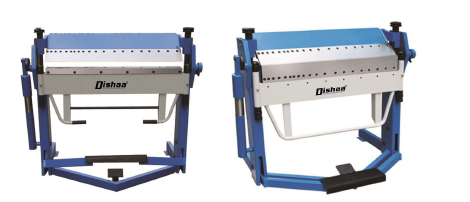
Introduction on Manual Folding Machine:
A manual folding machine, also known as a manual sheet metal bender or press brake, is an essential tool in the metal fabrication industry. It is used for bending, folding, and shaping sheet metal without the need for electricity or hydraulic systems. This cost-effective solution offers remarkable precision and control, making it ideal for small workshops, educational institutions, and industries where simple bending operations are needed without the complexity of CNC or hydraulic systems.
Manual folding machines operate using a hand-lever or foot-pedal mechanism that allows the user to bend the sheet metal at the desired angle. These machines are often used to create boxes, trays, angles, panels, and enclosures. The simplicity of design ensures minimal maintenance, easy operation, and long-lasting performance.
With growing demand for cost-efficient and flexible solutions, manual folding machines continue to hold significant value in modern fabrication. Their portability, energy-efficiency, and accuracy make them an excellent choice for both beginner and experienced fabricators.
In the evolving landscape of metal fabrication, efficiency, precision, and affordability are critical factors when selecting the right machinery. Among the diverse range of bending equipment available, the manual folding machine stands out as one of the most reliable and cost-effective tools for sheet metal forming. Whether for small-scale manufacturing, prototyping, or educational purposes, this machine remains a preferred choice for users who value simplicity, flexibility, and control.
A manual folding machine, also referred to as a manual sheet metal folder or box and pan brake, is a non-powered mechanical device used to bend or fold thin metal sheets into desired shapes and angles. Unlike hydraulic or CNC press brakes that require electrical or hydraulic power, a manual folder operates solely through human effort—either by hand lever, crank, or foot pedal—making it highly portable and energy-efficient.
Why to Use Manual Folding Machines?
– Cost-Effective: No electricity or compressed air required, making it highly affordable.
– Portability: Lightweight and compact design allows it to be moved or mounted as needed.
– Simplicity: Easy to operate with minimal training.
– Precision: Accurate bends due to calibrated angle guides and clamping mechanisms.
– Ideal for Small Batches: Great for customized or low-volume production jobs.
– Low Maintenance: With no motors or complex systems, maintenance is minimal.
– Environmentally Friendly: Energy-free operation means no carbon emissions.
Features:
- They have the function of air spring which can be installed inside the arm (optional)
- Our precision folding machine is used for bending the sheet metal parts. The upper blade can be dismantled for use. It can choose a combination of upper blades according to the abnormity degree and length of the workpiece.
- Heavy-Duty Frame Construction: Built with high-grade steel for long-term durability.
- Adjustable Back Gauge: Ensures consistent repeatability for bending operations.
- Segmented Folding Beam: For more complex shapes and customized folds.
- Quick-Clamp System: Allows for fast loading and unloading of sheet material.
- Graduated Angle Guide: Enables precise bend angle control.
- Manual Clamping and Folding: Offers hands-on precision for detailed work
- Compact Footprint: Suitable for limited workspace environments.
- Tool-Free Setup: Most units require minimal tools for changeovers.
Applications:
– HVAC Ductwork Fabrication
– Electrical Enclosure Manufacturing
– Custom Metal Boxes and Trays
– Roofing and Cladding Works
– Automotive Body Repair
– Signage and Display Panel Bending
– DIY Projects and Prototyping
– Educational Training and Workshops
Benefits:
– User-Friendly Design: No prior experience required for basic operations.
– Flexibility: Can handle multiple sheet sizes and thicknesses.
– Quick Setup and Operation: Ideal for urgent or on-site fabrication.- Durability: Long lifespan with little wear and tear.
– Economical Production: No operational costs related to power consumption.
– Versatility: Suitable for aluminum, mild steel, stainless steel, copper, and more.
– Customization: Easily adjustable for creating unique bends and profiles.
– Minimal Downtime: No risk of motor or hydraulic failure.
Limitations:
– Limited Automation: Not suitable for high-speed or mass production.
– Operator-Dependent: Quality may vary based on operator skill.
– Limited Thickness Capacity: Cannot handle very thick or heavy-duty metals.
– Manual Effort Required: Can be tiring for long or complex jobs.
– No CNC Integration: Limited compatibility with modern digital workflows.
– Slower Production Time: Compared to hydraulic or CNC bending systems.
Conclusion:
A manual folding machine remains an indispensable tool for many workshops and industrial environments. It offers an ideal combination of affordability, precision, and simplicity. Whether you’re a metalworker working on prototypes or a fabricator creating custom bends for enclosures or HVAC ducting, a manual sheet metal bender provides everything you need for quality results.
While not designed for high-speed or complex automated operations, it fills the gap for low-to-mid-volume bending needs, especially in areas with limited access to power. For businesses looking for an eco-friendly, budget-conscious, and easy-to-use solution, manual folding machines are an excellent choice.
Technical Parameters:
| Model | DPB1020/2.5 | DPB1270/2 | DPB1520/1.5 | DPB2020/1.2 | DPB2520/1.0 |
|---|---|---|---|---|---|
| Max. working length(mm) | 1020 | 1270 | 1520 | 2020 | 2520 |
| Max. sheet thickness(mm) | 2.5 | 2.0 | 1.5 | 1.2 | 1.0 |
| Max. clamping bar lift(mm) | 47 | 47 | 47 | 47 | 47 |
| Folding angle | 0-135° | 0-135° | 0-135° | 0-135° | 0-135° |
| Packing size (cm) | 146X62X127 | 170X71X127 | 196X71X130 | 247X94X132 | 297X94X132 |
| N.W.G.W.(kg) | 285/320 | 320/360 | 385/456 | 490/640 | 590/770 |